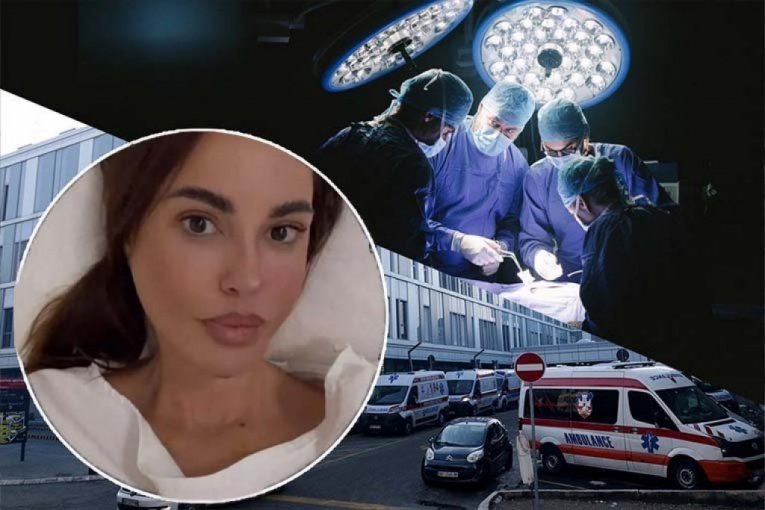




Designer and public figure Dijana Radonjić, known as Dijana Dilajn, was seriously injured in a scooter accident in Dubai, suffering a fractured jaw that required surgery after she returned to Belgrade. Following the operation, she developed complications affecting her facial nerve, leading to a temporary loss of function on the left side of her face, with associated hearing loss in her left ear and vision problems in her left eye. Pro-government outlets agree that her recovery has been slow but ongoing for about a month, during which she struggled to speak and eat and largely withdrew from public appearances before recently deciding to reveal details of her condition in media interviews and video content.
Coverage also converges on the medical and emotional context: the paralysis and sensory problems are presented as postoperative complications rather than injuries from the initial impact, and her current state is described as gradually improving with partial return of hearing and sight. Reports consistently place the events across two locations and phases—Dubai for the accident and Belgrade for surgery and recovery—framing her case within broader issues of nerve damage, the psychological weight of hiding such a condition from close family (especially children), and the importance of rehabilitation and medical follow‑up. Both sides, where they report on her at all, treat the case as a human‑interest health story illustrating the risks of seemingly routine leisure activities and the long, uncertain path of neurological recovery.
Points of Contention
Framing and tone. Opposition‑aligned outlets, where they cover the story, are more likely to describe the accident and subsequent paralysis in restrained, clinical language, focusing on medical causality and minimizing sensational phrasing, while still acknowledging the emotional burden. Pro‑government outlets tend to headline the story with dramatic terms like "horrifying" and "sadness," emphasizing shock, fear, and pathos to draw attention to her struggle. Both acknowledge the seriousness of her condition, but opposition coverage frames it as a sobering health episode, whereas pro‑government coverage leans into melodramatic storytelling and emotive cues.
Use of personal and family narrative. Opposition sources generally present Dijana Dilajn’s experience as primarily a health and safety issue, briefly mentioning family only where necessary and avoiding deep intrusion into private dynamics. Pro‑government outlets, by contrast, foreground her emotional vulnerability, stressing how she "hid the truth" from her children and what her loved ones "didn’t know she was going through," turning family reactions into a central narrative hook. The result is that opposition coverage treats her relatives as background context, while pro‑government coverage uses them as a lens for amplifying empathy and drama.
Institutional and systemic implications. Opposition‑aligned media, when touching on the incident, are more inclined to connect it—however lightly—to broader themes such as access to quality postoperative care, patient information about nerve‑damage risks, and the pressures on public health systems. Pro‑government outlets largely avoid systemic critique, keeping attention on her individual journey, resilience, and the competence of the Belgrade medical team that treated her after Dubai, thus reinforcing confidence in domestic institutions. The diverging emphasis means opposition coverage hints at structural lessons or policy conversations, whereas pro‑government reporting treats the case as an exceptional, personal ordeal rather than evidence of systemic issues.
Celebrity and public image. Opposition coverage tends to treat her mainly as an injured patient who happens to be a public figure, focusing on factual updates and her statements without heavily exploiting her celebrity status. Pro‑government outlets stress her media persona and previous visibility, using her status to heighten the sense of national concern and to frame her disclosure as a dramatic "confession" to the public. In this way, opposition sources normalize the episode as one more health story among many, while pro‑government sources leverage her fame to create a more spectacle‑driven narrative.
In summary, opposition coverage tends to treat Dijana Dilajn’s accident and facial paralysis as a sober health and safety case with limited emotional embellishment and occasional nods to systemic issues, while pro-government coverage tends to dramatize her ordeal through emotional language, family-focused storytelling, and emphasis on personal resilience and domestic medical care.
Story coverage