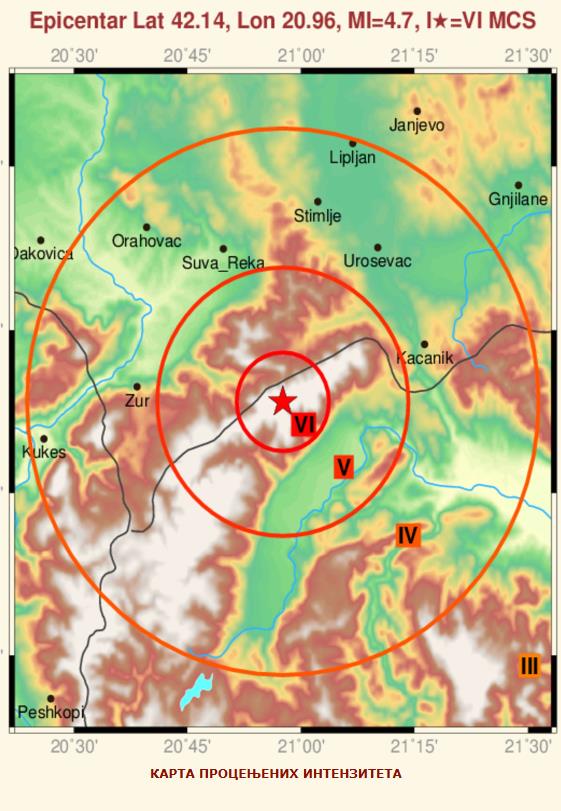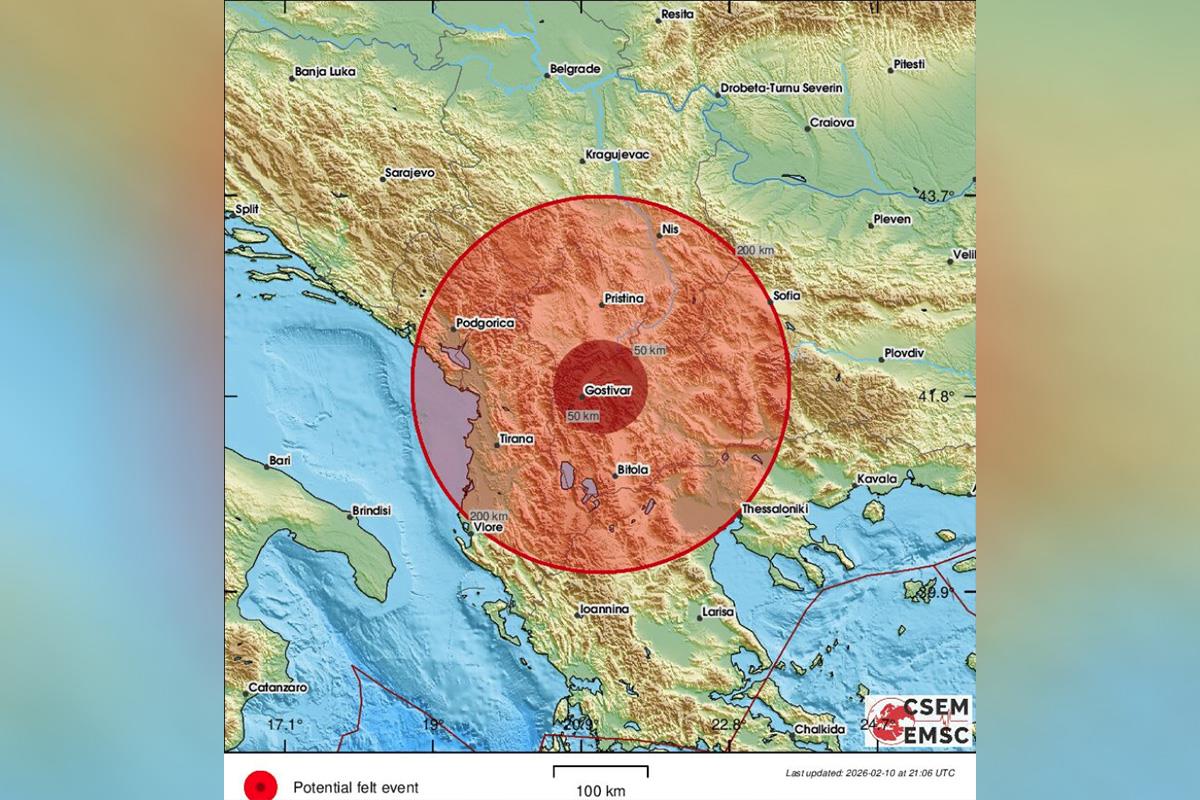



A series of seismic reports describe an earthquake in the 4.8–5.0 magnitude range on the Richter scale, with its epicenter placed near Prizren or in nearby North Macedonia, roughly 15 km from Tetovo at a shallow depth of about five kilometers. The tremor struck in the late evening, around 21:05–22:05 local time, and was felt across a wide area of the Balkans, including Kosovo, Metohija, North Macedonia, Albania, Montenegro, and large parts of southern and even central Serbia such as Niš, Leskovac, Gnjilane, Uroševac, and Belgrade. Eyewitness accounts across outlets concur that shaking lasted roughly 7–10 seconds, described as short but strong, causing people to run into the streets, evacuate residential buildings, and report moving furniture, swaying chandeliers, and goods falling from shelves. Both sides, where they report the event, agree that there have been no confirmed serious casualties, and that any reported damage has been minor and localized, such as in individual shops.
Across the spectrum, coverage situates the tremor within the broader seismic vulnerability of the Balkans, referencing prior earthquakes in North Macedonia and Kosovo and the region’s known tectonic activity. Outlets agree on the importance of regional seismic monitoring, repeatedly citing or echoing data from institutions such as the European-Mediterranean Seismological Centre and local seismological services, and noting that initial automated magnitudes (around 4.8) can be refined to a round 5.0 as more data arrive. Shared context also includes public-safety guidance: media on both sides highlight basic preparedness advice, emphasize staying calm, and implicitly frame the episode as a reminder of the need for continued investment in seismic monitoring, civil protection systems, and building safety standards rather than as a catastrophic disaster in itself.
Points of Contention
Epicenter and framing of location. Opposition-aligned sources are more likely to emphasize the epicenter as being directly near Prizren or within Kosovo’s territory, using the event to highlight local vulnerability and perceived gaps in emergency preparedness. Pro-government outlets, by contrast, often foreground North Macedonia as the origin point, positioning Prizren and Kosovo as affected but secondary zones and emphasizing cross-border tremors that reached Serbia. Where opposition coverage stresses the quake as a specifically Kosovar shock near Prizren, pro-government coverage tends to regionalize it and underline the impact in southern Serbia and the broader Balkans.
Scale of impact and damage. Opposition media typically stress images of panic, evacuated buildings, and falling goods as evidence that local authorities are not adequately prepared, sometimes giving more weight to citizen testimonies that suggest more substantial disruption. Pro-government outlets, while also using dramatic footage, rapidly pivot to reassuring frames that material damage is limited, there are no serious injuries reported, and life returned to normal quickly. Thus, opposition narratives lean toward portraying the quake as a serious test of state capacity, whereas pro-government narratives frame it as a frightening but ultimately manageable event.
Institutional competence and response. Opposition reporting tends to question the speed, coordination, and transparency of the response by Kosovo’s and neighboring governments, highlighting any delays in official communication, civil protection drills, or building inspections as symptomatic of broader governance failures. Pro-government outlets emphasize that seismological services, emergency systems, and media alerts worked as intended, citing rapid magnitude estimates, public information on safety procedures, and the absence of casualties as proof of competent management. While opposition sources may imply that institutions were reactive and unprepared, pro-government coverage stresses that existing systems functioned and that no extraordinary intervention was required.
Political and regional spin. Opposition-aligned sources are likelier to connect the earthquake to domestic political debates, invoking it as a metaphor for instability or as further evidence that authorities neglect infrastructure and disaster readiness, and sometimes underscoring Kosovo’s distinct needs. Pro-government outlets more often use the event to underline regional interconnectedness and Serbia’s role, highlighting that the quake was felt "all the way to Belgrade" and featuring Serbian eyewitnesses and experts, thereby reinforcing a narrative of national resilience and cross-border significance. Where opposition media may stress local grievances and governance critiques, pro-government media use the same tremor to bolster a story of a capable state embedded in a seismically active region.
In summary, opposition coverage tends to portray the near-Prizren earthquake as a locally centered shock that exposes weaknesses in preparedness and governance, while pro-government coverage tends to frame it as a region-wide but limited event that demonstrates effective institutions, minimal damage, and national resilience.
Story coverage