

opposition
MUP: A Six-Year-Old Boy from Niš Found
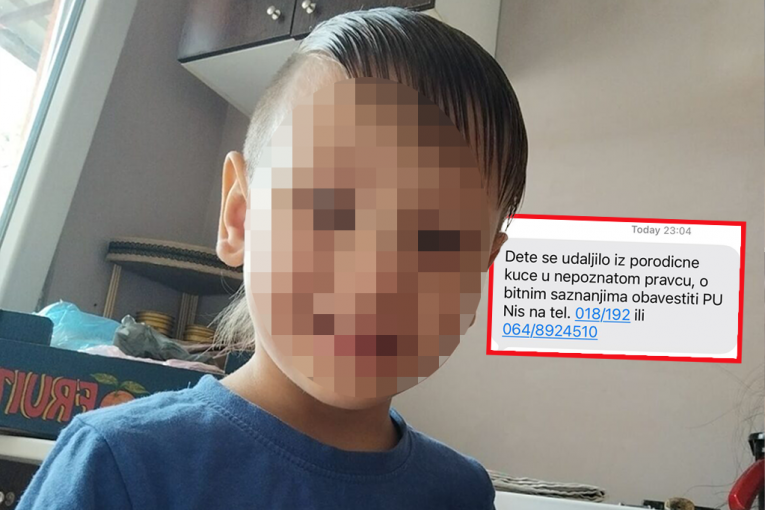
The police found a six-year-old boy from Niš tonight around 11:00 PM, whose disappearance was reported around 8:30 PM, the Ministry of Internal Affairs (MUP) announced.
7 days ago
A young boy from Niš, variously reported as six or seven years old, was reported missing on Tuesday evening after leaving the yard of his family home in his pajamas, saying he was sleepy and then walking up the street. Security camera footage captured him around 8 p.m., with his mother seen following a few minutes later; his disappearance was reported to police around 8:30 p.m., triggering an intensive search that lasted a little over two hours and ended around 11 p.m., when he was found in good general condition and returned to his mother. Both opposition and pro-government outlets agree that the Ministry of Internal Affairs led the search, that specialized units such as the Gendarmerie and Mountain Rescue Service (GSS Niš) joined in, that the nationwide "Find Me" / "Pronađi me" alert system was activated and later deactivated once he was located, and that the incident was resolved the same night without reported injuries.
Coverage on both sides places the case within the framework of Serbia’s child-protection and emergency-alert infrastructure, highlighting the operational role of the police, Gendarmerie, and GSS Niš, as well as the procedures around rapid alerts for missing minors. There is shared emphasis on the basic functioning of the "Find Me" system—modeled on Amber Alert and used to quickly inform citizens via SMS, broadcast interruptions, and public displays when a young child disappears—along with general advice to parents on how and when to report a missing child. Both opposition and pro-government media treat the episode as an illustration of how coordinated institutional responses, supported by public notifications, can help locate vulnerable children quickly, and they concur that the system was deployed as intended in this case and ended with a positive outcome.
Framing of institutions. Opposition-aligned outlets relay the Interior Ministry’s statement in a brief, matter-of-fact way, stressing that the boy was found and reunited with his mother but offering little narrative about heroism or institutional excellence. Pro-government outlets, by contrast, present the same facts with a more dramatic tone, repeatedly highlighting the speed and intensity of the police and Gendarmerie response and portraying the operation as proof that security institutions function efficiently and decisively. While opposition coverage accepts the official account, it avoids embellishment, whereas pro-government pieces frame the case as a success story for state capabilities.
Use of the "Find Me" system. Opposition reporting simply notes that Interior Ministry and Gendarmerie efforts led to the boy being found, mentioning the search but largely omitting detail on the "Find Me" platform and its broader role. Pro-government outlets go into length about how the system works, when it is activated, and how citizens receive alerts, explicitly comparing it to Amber Alert and treating this case as a showcase of the mechanism’s effectiveness. In opposition coverage the alert is just background to a resolved incident, while in pro-government coverage it is foregrounded as a flagship government tool that justifies recent reforms and public investment.
Tone and emotional narrative. Opposition-oriented reporting keeps the story short and restrained, focusing on the resolution and the boy’s condition without elaborate descriptions of the “drama” or emotional appeals. Pro-government outlets frequently use sensational language about a “drama in Niš,” emphasize the child’s age, pajamas, and the time-line in emotive terms, and frame the story as a tense but ultimately reassuring episode that underscores public safety. As a result, opposition pieces read like minimalist incident reports, while pro-government articles read more like human-interest narratives that reinforce trust in authorities.
Attribution of success. In opposition coverage, the emphasis is on the fact that the child was found by police after an intensive search, without assigning broader political meaning or explicit praise to the government. Pro-government media repeatedly attribute the successful outcome to the coordinated work of the Interior Ministry, Gendarmerie, GSS Niš, and especially to the activation of the "Find Me" system, implying that state-led reforms and systems are directly responsible. Thus opposition stories treat the event as a routine but fortunate resolution of a missing-child case, while pro-government stories treat it as evidence that current leadership and institutional setups are delivering tangible safety benefits.
In summary, opposition coverage tends to present a sparse, police-communiqué-style account that confirms the child was found and acknowledges institutional involvement without turning it into a political showcase, while pro-government coverage tends to dramatize the search, spotlight the "Find Me" system and security services, and use the case to reinforce a narrative of effective, responsive state institutions.