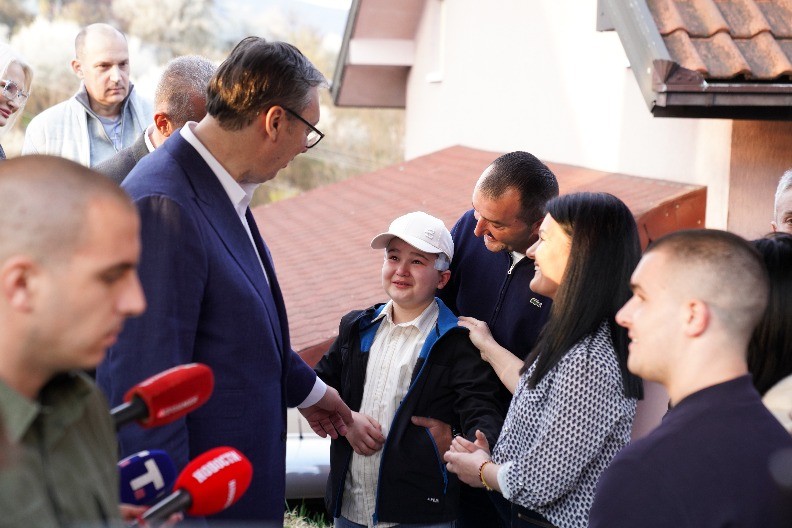


President Aleksandar Vučić visited the Knežević family in Bajina Bašta to see eight-year-old Andrija, a child suffering from the rare Moyamoya disease, with all major outlets agreeing on the core facts of time, place, and participants. Reports concur that Andrija became emotional during the encounter, that Vučić told him he had come that day only because of him, and that he promised the boy a special chess set, framing the visit as a highly personal and emotional moment.
Across the spectrum, coverage acknowledges that Moyamoya is a rare and serious condition requiring complex treatment that Serbia’s health system cannot yet fully provide, making treatment abroad necessary. There is broad agreement that the state has committed to cover the costs of Andrija’s current and future treatment through existing health and rare-disease funding mechanisms, and that this case is presented in the context of broader institutional efforts and budget allocations for rare-disease therapies and healthcare improvements.
Areas of disagreement
Framing of the visit. Pro-government media present the visit as a heartfelt, almost intimate gesture by a caring president whose priority is a sick child and his family, using emotional language and visuals to underscore his empathy. Opposition-aligned outlets, when they cover such visits, tend to frame them as carefully staged political performances designed for cameras, stressing timing, entourage presence, and media choreography. While supportive coverage focuses on the authenticity of Vučić’s emotions and his direct engagement with the boy, critical coverage questions the spontaneity and portrays the event as part of an ongoing personalist political branding strategy.
Role of the state and institutions. Pro-government reporting emphasizes that the state has fully assumed financial responsibility for Andrija’s treatment, using his case as proof that institutions and funding schemes for rare diseases are functioning effectively and improving. Opposition sources typically acknowledge that the state is paying but argue that individual interventions by the president highlight systemic gaps, suggesting that access depends on visibility, media attention, or presidential favor. Supportive narratives underline increased budgets, new therapies, and institutional compassion, whereas critical narratives stress uneven access, bureaucratic hurdles, and the need for predictable, depersonalized institutional pathways rather than ad hoc high-profile cases.
Healthcare system performance. Pro-government outlets underscore that Andrija’s need to go abroad stems not from neglect but from the objective rarity and complexity of Moyamoya, framing foreign treatment as responsible cooperation with advanced centers while domestic capacities are strengthened. Opposition-aligned coverage tends to interpret the reliance on foreign clinics as evidence of Serbia’s chronic underinvestment in specialized medicine and brain-drain of medical staff, using such cases to illustrate broader system weaknesses and delayed reforms. Supportive media highlight progress, such as rising health expenditures and improved access to rare-disease drugs, while critics stress persistent overcrowding, outdated equipment, and regional disparities in care.
Personalization versus policy. Pro-government narratives lean heavily on Vučić’s direct promises to Andrija and his parents, foregrounding his personal involvement and emotional responses as a guarantee that the state will deliver. Opposition-oriented reporting, by contrast, often argues that such personalization blurs the line between institutional duty and individual benevolence, suggesting that policies and legal entitlements should be center stage, not the president’s image. While supportive outlets treat the president’s presence as added value and reassurance on top of formal mechanisms, critical outlets cast it as a substitute for robust, transparent and rights-based healthcare policies.
In summary, opposition coverage tends to treat the Bajina Bašta visit as a personalized, media-driven spectacle that exposes systemic healthcare shortcomings, while pro-government coverage tends to depict it as a genuine act of compassion that demonstrates a responsive state and a president personally committed to helping children with rare diseases.