
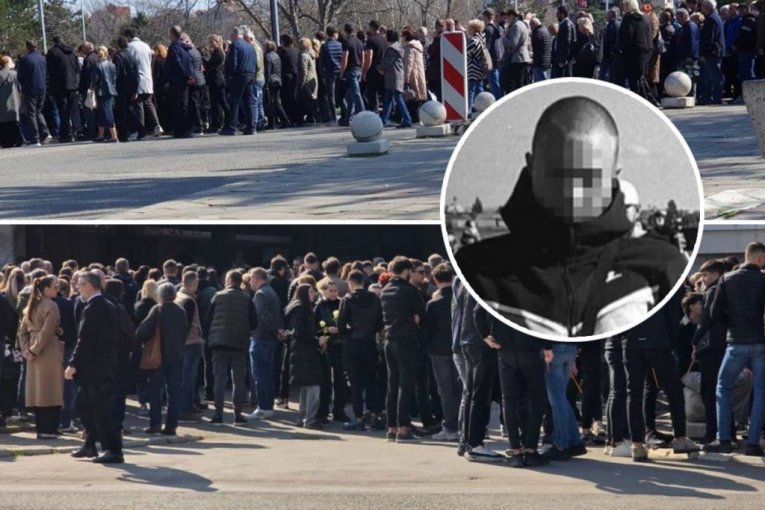
The outlets agree that a funeral was held for 19‑year‑old Mihajlo S., one of the teenagers killed in a traffic accident near Ugrinovci, with burial taking place at the New Bežanija (Batajnica) cemetery in Belgrade. They describe a deeply emotional ceremony attended by family and friends, emphasizing the grief of Mihajlo’s parents and the intense mourning that marked the farewell, alongside references to the burial of his peer Neda P., who died in the same crash. All sources concur that the accident occurred when the car the teenagers were in left the roadway and ended up in a canal near the settlement of Busije, and that the circumstances of the crash, including speed at the moment of the accident, are part of the public discussion.
Both sides frame the event within a broader context of road safety and the vulnerability of young drivers, acknowledging that Serbia has recurring tragedies involving youth in traffic accidents. They highlight the role of official investigations and expert assessments in determining the speed and technical circumstances, as well as the wider debate on whether better infrastructure, stricter enforcement, or educational reforms are needed to prevent similar incidents. Coverage also notes the emotional and social impact on the local community, treating the case as one more example of how institutional responses, from police to road authorities, will be scrutinized in the aftermath of such fatalities.
Areas of disagreement
Responsibility and blame. Opposition outlets tend to question whether systemic negligence by authorities, poor road conditions, or weak enforcement contributed to the crash, implying that the state bears a share of responsibility beyond the driver. Pro‑government outlets focus more on presenting the incident as a tragic accident, emphasizing the grief of the family and avoiding direct criticism of institutions or infrastructure. While opposition sources highlight patterns of repeated youth fatalities as evidence of governance failures, pro‑government reporting largely individualizes the tragedy and downplays broader culpability.
Speed and driving behavior. Opposition‑aligned media are more likely to highlight or at least leave open the possibility of excessive speed or risky behavior by the young driver, sometimes citing early, unofficial claims about speeding. Pro‑government coverage prominently features the father’s assertion that an established speed of around 110 km/h is not excessive for that road section, thereby countering narratives that blame Mihajlo’s driving. In this way, opposition outlets lean toward scrutinizing the driver’s and peers’ responsibility as part of a wider culture of dangerous driving, while pro‑government outlets stress that premature accusations against the deceased are unfair and possibly inaccurate.
Institutional accountability and reform. Opposition sources typically use the case to question police transparency, the quality of forensic investigation, and government commitment to road‑safety reforms, tying this death to recurring promises that have not been fulfilled. Pro‑government media instead present institutional actions, such as speed assessments and official statements, as credible and sufficient, framing them as evidence that the system is functioning. Thus, the former press for deeper structural changes and independent oversight, while the latter imply that existing mechanisms are adequate and that this was primarily a heartbreaking misfortune.
Tone and political framing. Opposition coverage tends to connect the tragedy to a broader critique of the current administration, arguing that repeated accidents involving youth reflect a climate of lawlessness and disregard for public safety. Pro‑government outlets adopt a more apolitical, human‑interest tone, centering on the pain of the family, religious and burial rituals, and emotional scenes at the cemetery, with minimal linkage to political debates. As a result, opposition media situate the funeral within a narrative of systemic crisis, whereas pro‑government media seek to de‑politicize the event and preserve it as a personal and communal loss.
In summary, opposition coverage tends to politicize the tragedy by foregrounding institutional responsibility, possible systemic failures, and contested details about speed and safety, while pro-government coverage tends to depoliticize it, emphasizing family grief, the father’s defense of his son, and trust in official findings.