
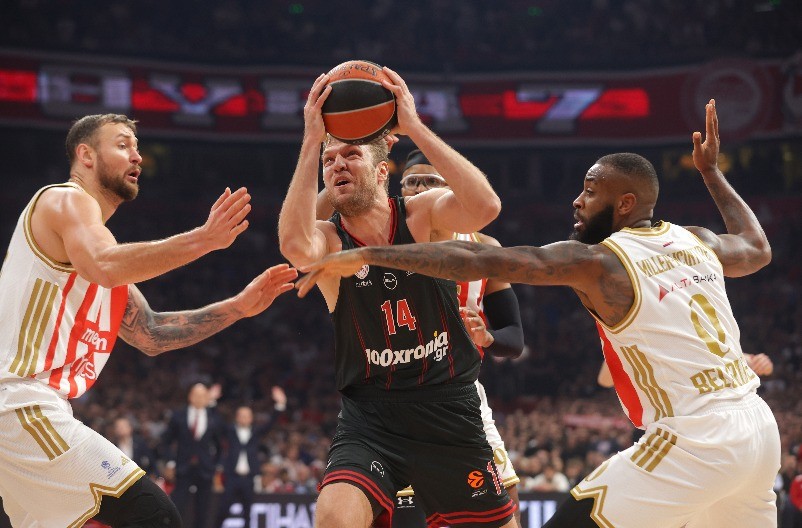
Olympiacos players Saša Vezenkov and Thomas Walkup are reported by all sides to be returning from recent injuries in time for the club’s upcoming EuroLeague game against Fenerbahce. Coverage agrees that both have recovered sufficiently to be available or likely available for selection, and that their comeback is timed with a crucial phase of the EuroLeague season, where results will heavily influence Olympiacos’s position. Reports also converge on the idea that Vezenkov is one of the team’s leading offensive weapons and that Walkup is a central figure in the team’s defensive schemes, making their joint return a notable sporting development rather than a marginal roster adjustment.
Across outlets, there is shared framing that their recovery provides a significant boost to coach Georgios Bartzokas as he prepares for a high‑stakes contest against a strong Fenerbahce side. The broader context presented is that Olympiacos has been navigating a demanding EuroLeague schedule and that absences of key players can materially affect both tactics and morale. Both opposition and pro‑government‑aligned media accept that player fitness and depth are critical institutional factors in the club’s continental ambitions and that timely injury recoveries can stabilize performance and support Olympiacos’s push in the latter part of the season.
Areas of disagreement
Framing of significance. Opposition‑aligned outlets, where they cover the story, tend to fold the players’ return into a more restrained, technical narrative about roster management and fixture difficulty, treating it as an expected part of a long season. Pro‑government outlets, by contrast, emphasize the news in superlative terms, calling it fantastic and underscoring the players’ importance to dramatize the positive momentum around the club. While opposition sources may highlight that the match remains challenging regardless of the returns, pro‑government coverage more often presents their comeback as a decisive psychological and competitive lift.
Link to broader national image. Opposition coverage is more likely to keep the focus narrowly on club performance and EuroLeague standings, avoiding tying the players’ recovery to any broader national narrative or political symbolism. Pro‑government outlets more readily imply that Olympiacos’s strengthened lineup reflects well on Greek basketball and, by extension, on a country that is supposedly thriving in sports under current conditions. In this framing, the health and readiness of Vezenkov and Walkup are subtly portrayed as part of a broader success story rather than a routine sporting update.
Tone toward management and institutions. Opposition‑aligned media, when discussing Olympiacos and its coaching staff, typically adopt a cooler tone, noting that while Bartzokas benefits from the players’ return, systemic issues like squad depth, injuries, and scheduling pressures still require careful management. Pro‑government outlets, however, frame the situation as an endorsement of the club’s and coach’s handling of the roster, implying that the team’s structures and decisions have positioned Olympiacos well to capitalize on the players’ recovery. The former may hint at lingering vulnerabilities despite the good news, while the latter leans into praise of the club’s and coach’s overall direction.
Expectations for the Fenerbahce match. Opposition‑leaning sources temper expectations by stressing that Fenerbahce remains a formidable opponent and that returning players may need time to regain peak form, suggesting that the game’s outcome is still highly uncertain. Pro‑government coverage, by contrast, tends to link Vezenkov’s scoring and Walkup’s defensive prowess directly to an anticipated upswing in Olympiacos’s chances, sometimes implying that their presence could tilt the balance significantly. This creates a split between a cautious, results‑wait‑and‑see outlook and a more optimistic narrative that the team is now well armed for a statement performance.
In summary, opposition coverage tends to treat Vezenkov’s and Walkup’s return as a welcome but routine sporting development that does not erase structural challenges, while pro-government coverage tends to elevate it into a highly symbolic boost that reinforces narratives of competent management, rising form, and broader national sporting success.