

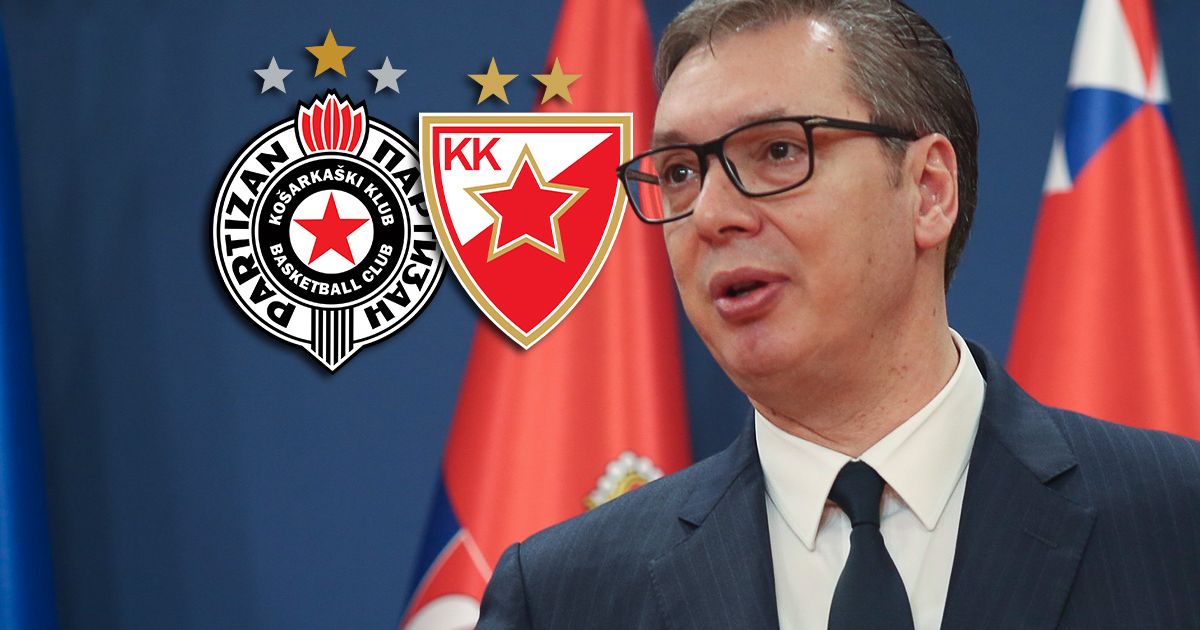
President Aleksandar Vučić, speaking as a self-declared Crvena zvezda fan, publicly criticized the club’s recent performances, focusing on what he described as poor defense and a lack of discipline, especially in Euroleague games. He contrasted this with strong praise for Partizan’s coach Joan Penarroya, commending Partizan’s consistent 40-minute focus, structured play, and defensive effort, while also reiterating that Željko Obradović remains, in his view, the greatest coach of all time. Across the spectrum, outlets note that Vučić said he would be happy if Crvena zvezda reached the Euroleague Final Four and that he initially imagined a Final Four dominated by Balkan clubs, situating his comments within broader regional basketball ambitions.
Coverage from both opposition-aligned and pro-government media agrees on the basic setting: these remarks came in the context of Vučić commenting on Euroleague prospects and the state of Serbia’s top basketball clubs. Both sides highlight that Vučić is emotionally invested as a supporter of Crvena zvezda, that he nonetheless voiced unusually sharp criticism of their discipline and defense, and that he framed Partizan’s hiring of Penarroya as a strong long-term move. The shared context in all reporting is that basketball, and particularly the rivalry between Crvena zvezda and Partizan, is a significant social and political touchstone in Serbia, and that a sitting president publicly evaluating coaching and club performance reflects the intertwining of sports, national pride, and political visibility.
Areas of disagreement
Tone and intent of criticism. Opposition outlets tend to frame Vučić’s criticism of Crvena zvezda as intrusive and politically tinged, suggesting he is overstepping by publicly reprimanding a club and using sporting discourse to maintain visibility. Pro-government media present the same remarks as those of a passionate fan and knowledgeable observer, emphasizing that he speaks candidly out of concern for Serbian basketball. While opposition sources highlight the harshness and potential ulterior motives behind his comments, pro-government outlets cast them as constructive, even supportive, criticism.
Role of the president in sports. Opposition coverage argues that Vučić’s detailed assessments of tactics, discipline, and coaching exemplify unhealthy presidential involvement in club affairs and a broader pattern of politicizing sports institutions. Pro-government outlets instead normalize his engagement, portraying it as evidence that the president is close to the people and shares ordinary fans’ worries and hopes. The former warn about blurred lines between state power and club management, while the latter stress that he is not interfering formally but merely voicing opinions like any other supporter.
Framing of praise for Partizan and Penarroya. Opposition-aligned sources interpret Vučić’s strong praise for Partizan’s coach and emphasis on discipline and structure as a backhanded way to pressure or disparage Crvena zvezda’s current leadership, feeding speculation about political favoritism toward particular clubs or management circles. Pro-government media frame the same praise as neutral, merit-based recognition of good coaching, insisting it shows Vučić can separate personal club loyalties from objective assessment. Where opposition narratives see signaling and possible maneuvering behind the compliments, pro-government coverage highlights sportsmanship and fairness.
Political symbolism of Zvezda vs Partizan. Opposition media often embed the episode in a larger story about how partisan politics maps onto club rivalries, hinting that Vučić’s comments play into existing perceptions of certain clubs being closer to the ruling establishment. Pro-government outlets largely downplay or ignore this symbolic dimension, treating Zvezda and Partizan primarily as sports brands and insisting that Vučić’s remarks are devoid of partisan coding. Thus, opposition reporting uses the incident to question the neutrality of state power in everyday arenas like sport, while loyal outlets stress national unity and a shared ambition for Serbian teams in European competitions.
In summary, opposition coverage tends to interpret Vučić’s remarks as another example of political overreach into sports and a tool for shaping perceptions of favored clubs and coaches, while pro-government coverage tends to present the same comments as honest, fan-like engagement that reflects his passion for basketball and balanced support for both major Serbian teams.
.jpg)