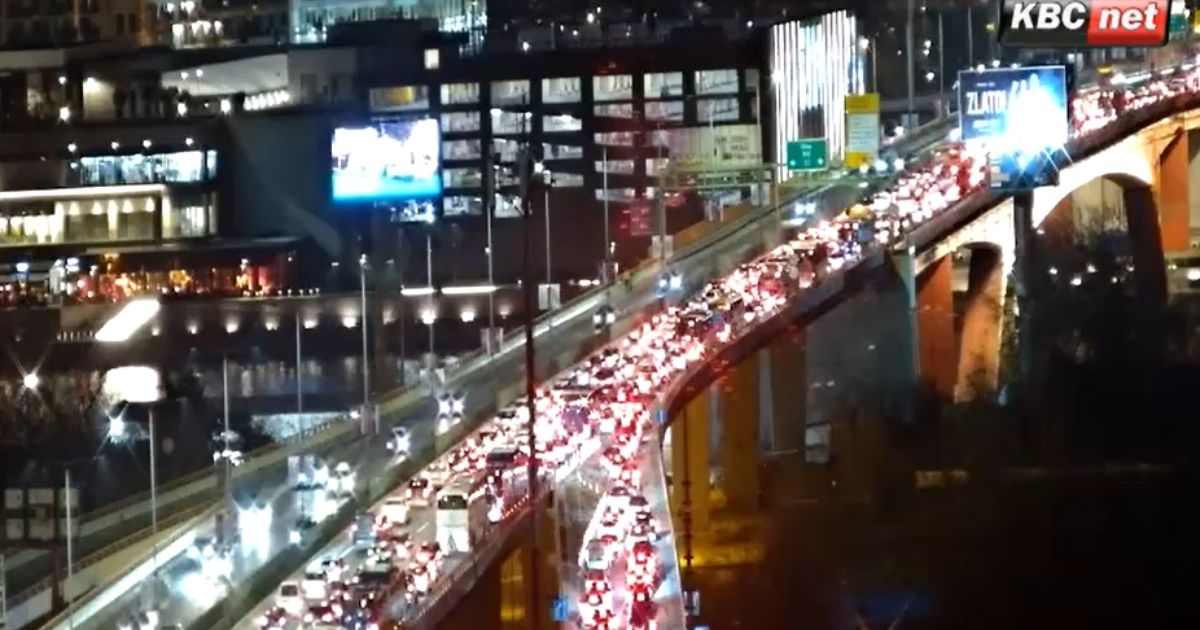

A chain collision involving five vehicles occurred on the Gazela bridge in Belgrade around 7:40 pm, near the Mostarska petlja, with outlets agreeing that at least one person reported injuries. Both opposition and pro-government media state that the accident led to major traffic disruption, noting that traffic toward New Belgrade was either halted or heavily obstructed, and that one vehicle ended up in the opposite lane, blocking at least one lane there as well. They concur that emergency services were present at the scene and that the incident created a serious traffic bottleneck in a key urban artery.
Both sides also agree on the basic contextual frame: Gazela is one of Belgrade’s most critical bridges, so any accident there quickly causes wider gridlock in the city during busy hours. Coverage from both camps implicitly treats the accident as part of broader traffic-safety concerns on major city routes, citing the need for cautious driving and proper post-accident behavior. They highlight the role of emergency and traffic services in managing such incidents, and acknowledge that chain collisions on heavily used infrastructure like Gazela can expose systemic vulnerabilities in traffic flow and safety, even when only one injury is initially reported.
Areas of disagreement
Severity and framing of the incident. Opposition-aligned outlets describe the event in a more restrained tone, focusing on it as a disruptive but routine traffic accident with one injured person and significant congestion. Pro-government outlets frame it as a heavy or serious chain collision, using stronger language and emphasizing that traffic toward New Belgrade completely stopped and that a car crossed into the opposite lane. This differing tone shapes whether the incident is perceived as an alarming event demanding attention or a typical, if inconvenient, occurrence on a major bridge.
Focus of coverage. Opposition sources keep their reports brief and fact-centric, centering on the number of vehicles, the location, the time, and the immediate traffic obstruction. Pro-government coverage devotes more space to prescriptive content, including detailed instructions on how drivers should behave after an accident, such as turning off the engine, using hazard lights, wearing reflective vests, and placing warning triangles. As a result, opposition reporting reads as a short traffic bulletin, while pro-government reporting doubles as a public-safety primer that partially shifts attention away from the incident itself.
Implications for institutions and infrastructure. Opposition reports, by staying minimalist and not highlighting official reactions, implicitly leave open questions about road safety management and the resilience of urban infrastructure when a single accident paralyzes a main bridge. Pro-government outlets, in contrast, underscore the rapid involvement of emergency services and frame the event as largely a matter of individual driver responsibility and proper conduct. This contrast results in opposition coverage hinting at systemic vulnerability without elaboration, while pro-government coverage subtly reinforces the image of responsive institutions and emphasizes citizen behavior.
In summary, opposition coverage tends to present the Gazela chain collision as a concise traffic incident report that underscores disruption without extensive narrative, while pro-government coverage tends to dramatize the severity, spotlight the role of emergency services, and expand into didactic guidance that reinforces themes of individual responsibility and institutional responsiveness.
Story coverage