pro-government
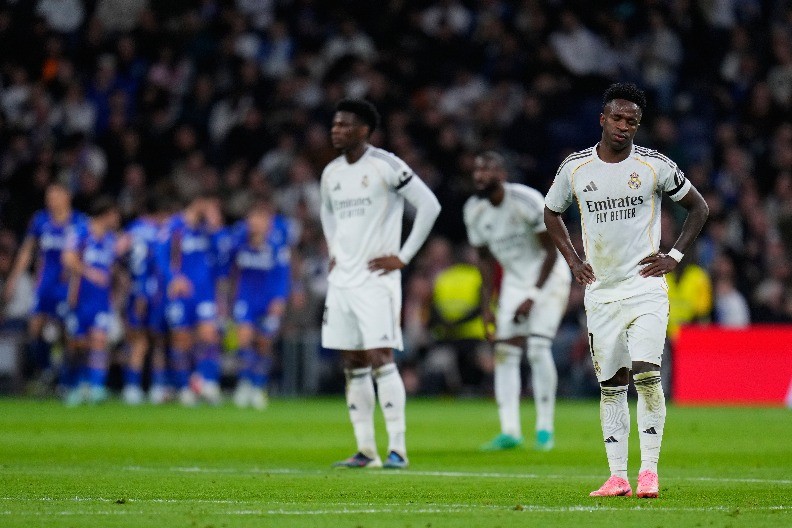
SILENCE IN MADRID Real's Shocking Defeat
A huge slip-up by the Madrid team
a month ago
Real Madrid suffered a 1-0 away defeat to Getafe in the 26th round of La Liga, with the only goal coming from Martin Satriano in the 39th minute via a well-struck volley. Coverage converges on the basic match narrative: Madrid dominated possession and created a number of second-half chances but failed to score, Getafe held firm defensively, and the encounter ended with two red cards issued in a tense closing phase.
Across outlets there is agreement that this was a shock result and a significant setback for Madrid in the context of the league campaign, given expectations that they should comfortably beat a lower-profile opponent like Getafe. Both sides frame the match as exposing weaknesses in Madrid’s performance and mentality, referencing the result as emblematic of a broader lapse or misstep rather than an isolated, unlucky incident, and situating it within ongoing scrutiny of the team’s consistency and tactical balance.
Responsibility and blame. Opposition-aligned sources are likely to place sharper blame on club leadership and coaching decisions, arguing that tactical complacency and poor squad rotation directly produced the defeat. Pro-government outlets, by contrast, emphasize an individual “considerable error” and a “substantial failure” in execution on the day, framing it more as a bad performance than a deep structural problem. While opposition coverage might link the loss to long-running mismanagement, pro-government reporting tends to isolate responsibility to the players’ focus and mistakes in this specific match.
Significance of the defeat. Opposition narratives are prone to portray the loss as a major turning point in the title race or as proof of systemic decline, amplifying its symbolic weight beyond three dropped points. Pro-government outlets still call it a “shocking defeat” and a “major misstep,” but usually couch it as a temporary setback from which the team can recover. The former stresses long-term damage to credibility and momentum, while the latter downplays existential implications and insists the season’s objectives remain attainable.
Evaluation of Getafe’s role. Opposition-aligned media may acknowledge Getafe’s discipline yet focus primarily on Madrid’s deficiencies, implying that almost any organized opponent could have exposed them in similar fashion. Pro-government coverage more readily credits Getafe’s compact defending, defensive heroics, and opportunistic finishing, presenting the result as a combination of Madrid’s off day and the opponent’s exceptional resilience. This leads opposition reports to speak in terms of Madrid “beating themselves,” while pro-government pieces highlight that a well-prepared rival exploited limited chances effectively.
Implications for reforms and future changes. Opposition commentators tend to use the defeat as evidence for urgent reforms in squad planning, tactical approach, or even leadership changes, suggesting that without substantial adjustments similar setbacks will recur. Pro-government sources, however, are likelier to argue for continuity and incremental tweaks, framing the loss as a warning that demands focus and minor corrections rather than sweeping overhauls. As a result, opposition voices talk about the match as a catalyst for major restructuring, whereas pro-government voices present it as a lesson to refine, not to rebuild.
In summary, opposition coverage tends to interpret the 1-0 defeat to Getafe as proof of deeper structural failings and a need for far-reaching changes, while pro-government coverage tends to treat it as an embarrassing but contained misstep explained by individual errors, Getafe’s strong display, and correctable shortcomings in execution.