
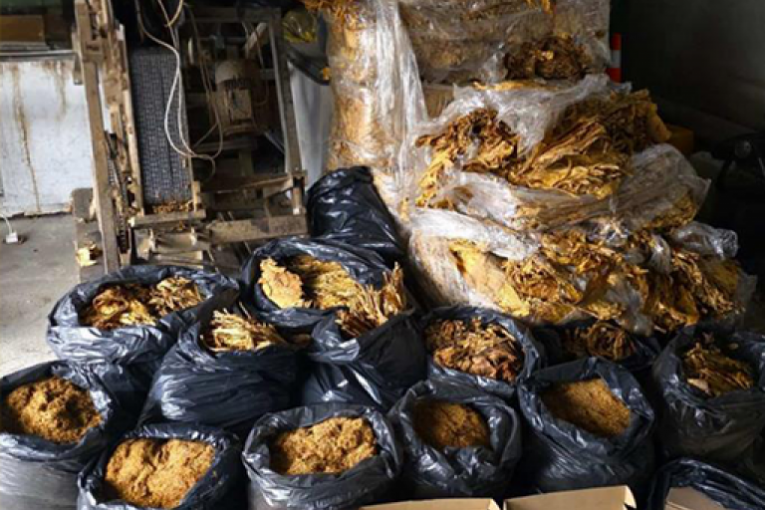
Police and prosecutorial sources across the spectrum report that officers from the Sremska Mitrovica police, acting on the order of the Public Prosecutor’s Office in Stara Pazova, searched a property in the village of Golubinci. During the search, they discovered close to 430 kilograms of untaxed tobacco products, including about 370 kilograms of leaf tobacco, 57.07 kilograms of cut tobacco, and a tobacco‑cutting machine or knife; preliminary financial estimates put the damage to the budget of the Republic of Serbia at roughly 4,827,110 dinars.
Coverage agrees that the case is being handled as part of efforts to combat illicit tobacco trade that deprives the state of excise and tax revenues, with the haul presented as significant in both scale and fiscal impact. Outlets broadly situate the incident within the institutional framework of cooperation between the police and the local public prosecutor’s office, emphasizing that the seized tobacco would have entered the gray market, undermining legal producers and the state budget, and that the authorities are expected to continue such operations as part of ongoing enforcement.
Points of Contention
Framing of law enforcement effectiveness. Opposition-aligned outlets are likely to acknowledge the seizure but frame it as routine policing that is being overstated by authorities to create a sense of efficiency, implying that larger smuggling networks remain untouched. Pro-government media instead highlight the operation as proof that the police and prosecution are highly effective, stressing the precision of the action and the exact value of budget damage as evidence of serious analytical work. While opposition coverage would downplay the strategic importance of this single bust, pro-government narratives emphasize it as a showcase success in a broader security policy.
Political significance and messaging. Opposition sources tend to interpret such reports as part of a political communication strategy, suggesting that state media use economic-damage figures and photo galleries of seized goods to distract from systemic issues like high-level corruption or links between officials and major contraband networks. Pro-government outlets, by contrast, present the case in an apolitical tone that foregrounds rule of law and fiscal protection, implying that the state is neutral and firm regardless of who is involved. The former emphasize possible instrumentalization of police work for image-building, while the latter portray it as straightforward informative reporting.
Systemic causes and accountability. Opposition-aligned commentary often connects tobacco seizures to broader structural problems such as poverty, weak oversight of customs, and alleged political patronage over smuggling routes, arguing that minor actors are targeted while key beneficiaries remain protected. Pro-government coverage generally isolates the event from such systemic critiques, treating it as an individual criminal case and underscoring the role of institutions rather than questioning them. Thus, opposition narratives stress deeper accountability deficits, whereas pro-government narratives limit accountability to the immediate suspects.
Economic and social impact. Opposition outlets are prone to question whether the highlighted budget damage figure reflects a genuine concern for public finances, pointing to perceived government waste or mismanagement that dwarfs the sum seized, and sometimes noting the socioeconomic pressures that push people into the gray economy. Pro-government media instead foreground the 4.8 million dinars as a concrete, relatable number that illustrates how smuggling harms all citizens by siphoning funds from public services, casting the perpetrators as undermining collective welfare. This leads opposition narratives to relativize the significance of the amount against broader fiscal issues, while pro-government narratives use it to moralize the case and rally support for strict enforcement.
In summary, opposition coverage tends to treat the Golubinci seizure as a modest, possibly politicized showcase that diverts attention from systemic corruption and deeper economic problems, while pro-government coverage tends to present it as a clear-cut success story proving that institutions are effectively protecting the state budget and enforcing the law.