

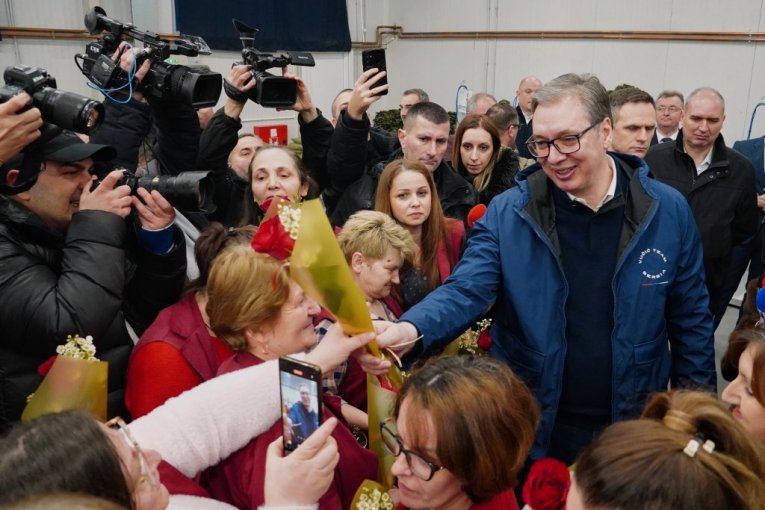
President Aleksandar Vučić announced that workers at the state-linked textile company Jumko, particularly women employed at the plant in Rudna Glava and other Jumko facilities, will receive a one‑time financial aid payment of 20,000 dinars timed around March 8, International Women’s Day. He also stated that all women currently working on fixed-term contracts at Jumko’s Rudna Glava plant will be given permanent contracts by the end of May, alongside plans to hire additional female workers, and linked this to broader infrastructure projects and future pension increases in the area.
Across reports, it is agreed that Jumko is a state‑connected company whose survival and workload depend heavily on government decisions and public contracts, and that the announced measures are part of a wider pattern of state financial support and employment guarantees in less developed regions. Coverage converges on the idea that these moves are framed as instruments of social and regional policy—tied to job security, support for women workers, and investment in local infrastructure—while also being situated within Vučić’s ongoing narrative of economic assistance, pension growth, and support to strategic or vulnerable enterprises.
Points of Contention
Motives and timing. Opposition-aligned sources tend to frame the 20,000 dinar aid and conversion of contracts as pre‑electoral or image‑building gestures, timed around a symbolic date and media events to maximize political gain, whereas pro‑government outlets present them as a natural continuation of Vučić’s broader policy of economic support and social solidarity. While opposition media emphasize the spectacle and personalization of the announcement, pro‑government reporting underscores continuity with earlier aid packages and regional development plans.
Economic sustainability. Opposition coverage often questions whether Jumko’s aid and promised permanent jobs are fiscally and commercially sustainable, portraying the company as structurally dependent on subsidies and politically allocated orders, while pro‑government outlets stress state responsibility to keep factories in poorer areas alive and to secure new contracts. The former highlight risks of long‑term budgetary strain and lack of genuine competitiveness, while the latter frame the measures as necessary investments in employment, especially for women, in deindustrialized regions.
Responsibility and criticism. Opposition media typically assign responsibility for Jumko’s precarious situation to years of government mismanagement and clientelism, arguing that one‑off payments cannot compensate for systemic neglect, whereas pro‑government outlets depict Vučić as correcting past problems and shielding workers from earlier failed privatizations and economic shocks. In this narrative, opposition criticism is presented in pro‑government coverage as obstructive or indifferent to workers’ immediate needs, while opposition sources see the same criticism as defense of institutional and market discipline.
Workers’ agency and long‑term reforms. Opposition reports tend to stress that workers at companies like Jumko remain vulnerable and dependent on political goodwill, with limited say in company governance or broader industrial policy, while pro‑government outlets focus on the gratitude and relief among employees who are getting permanent contracts and direct cash aid. The former argue for deeper structural reforms, transparent procurement, and depoliticized management as the real solutions, whereas the latter foreground concrete short‑term benefits and pledges of continued state support as evidence that current policies are delivering.
In summary, opposition coverage tends to portray the Jumko aid and contract promises as politicized, short‑term concessions masking deeper structural weaknesses, while pro-government coverage tends to present them as responsible, compassionate state interventions that protect vulnerable workers and demonstrate Vučić’s commitment to regional development.
