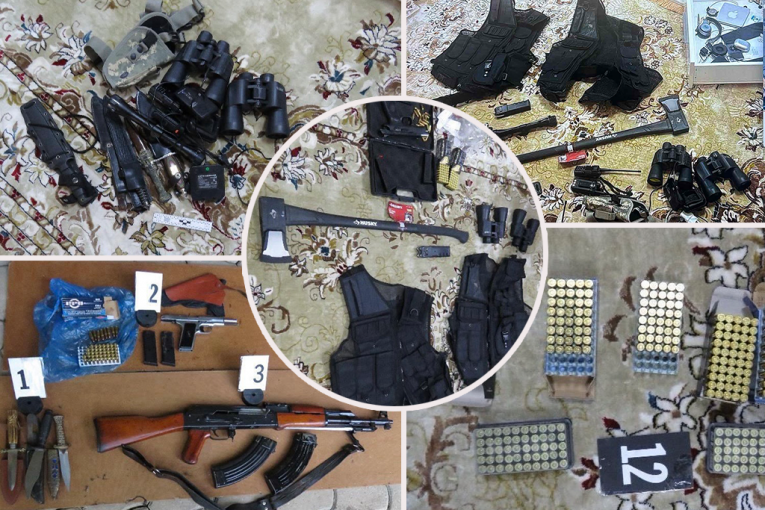



Police and prosecutors in North Macedonia say they thwarted a planned terrorist attack after receiving a warning from the FBI about online threats made by a 20-year-old man from the Tetovo region. Both opposition and pro-government outlets agree that the suspect used the Discord platform to threaten a firearms attack, explicitly referencing the 2012 Sandy Hook Elementary School shooting in the United States as an inspiration, and that he mentioned mental health problems in his communications. They report that following the FBI tip, Macedonian authorities identified and arrested the suspect, searched his home and related premises, seized a significant cache of firearms and ammunition, and filed charges of terrorism and illegal weapons possession; in some accounts, a second person, reportedly a grandfather or close relative, also faces charges linked to illegal firearms. All sides note that a public prosecutor has requested, and the court has imposed or is considering, a 30-day pretrial detention measure as the investigation continues.
Across the spectrum, coverage situates the case within the framework of North Macedonia’s cooperation with US law enforcement and international counterterrorism mechanisms, highlighting the role of the FBI in flagging the Discord threats and the subsequent coordination with domestic police and prosecutorial institutions. There is broad agreement that the episode underscores vulnerabilities related to online radicalization or emulation of high-profile US mass shootings, as well as gaps in monitoring individuals with declared mental health problems who acquire access to weapons. Outlets on both sides reference the involvement of the Basic Public Prosecutor’s Office and the Basic Court in Skopje to emphasize that the case is being handled through formal legal channels under the existing criminal code on terrorism and illegal arms. They also converge on the idea that the seizure of the weapons arsenal and the swift operational response prevented a potentially deadly attack in a public setting, even if they differ in how much they credit particular institutions or political actors.
Points of Contention
Framing of state performance. Opposition-aligned sources tend to present the foiling of the plot as evidence of systemic weaknesses, arguing that domestic security services were reactive and heavily dependent on the FBI tip rather than on their own intelligence capabilities. Pro-government outlets, by contrast, emphasize the operation as a success story for the police and judiciary, highlighting the speed of the arrest, the size of the seized arsenal, and the imposition of detention as proof that institutions are functioning effectively. While opposition media stress what could have gone wrong and question why the suspect’s risk factors were not detected earlier, pro-government coverage stresses what went right and frames the case as validation of current security structures.
Political accountability and credit. In opposition narratives, responsibility is diffused across current and past governments, but they are more inclined to criticize the sitting authorities for failing to reform gun laws, mental health support, and online threat monitoring, sometimes portraying the case as a near-miss rather than an unqualified success. Pro-government media, on the other hand, frequently connect the successful intervention to the ruling coalition’s leadership, pointing to established cooperation with US agencies and to recent legal amendments as groundwork for the rapid response. Where opposition outlets downplay or omit direct praise for ministers or party leaders, government-aligned outlets often feature statements from officials and use the episode to reinforce their claim that the country is a reliable security partner.
Security policy implications. Opposition coverage often uses the incident to argue for deeper structural reforms, including stricter controls on privately held weapons, improved mental health services, and more transparent oversight of intelligence units, suggesting that the current framework remains inadequate. Pro-government coverage generally backs more incremental adjustments, such as refining online threat detection and maintaining close ties with foreign partners, while defending existing legal tools as largely sufficient. The opposition press frames the plot as a warning that ad hoc cooperation with the FBI cannot substitute for robust domestic prevention, whereas pro-government outlets treat it as proof that the current combination of laws, police practice, and international cooperation works when tested.
Civil liberties and public communication. Opposition-leaning media are more likely to question the balance between aggressive counterterrorism measures and protection of rights, raising concerns about how online speech on platforms like Discord will be monitored in the future and warning against politicized use of terrorism charges. Pro-government outlets focus instead on the necessity of strong measures, portraying pretrial detention, broad search powers, and public display of seized weapons as justified and reassuring to citizens. While opposition narratives call for clearer criteria, independent oversight, and careful public messaging to avoid panic or stigmatization, pro-government narratives emphasize deterrence and public confidence, arguing that visibly tough action helps prevent copycat threats.
In summary, opposition coverage tends to use the foiled plot to highlight institutional vulnerabilities, demand broader reforms, and question how authorities balance security with rights, while pro-government coverage tends to portray the case as a demonstration of effective governance, successful international cooperation, and the adequacy of current security and legal frameworks.