
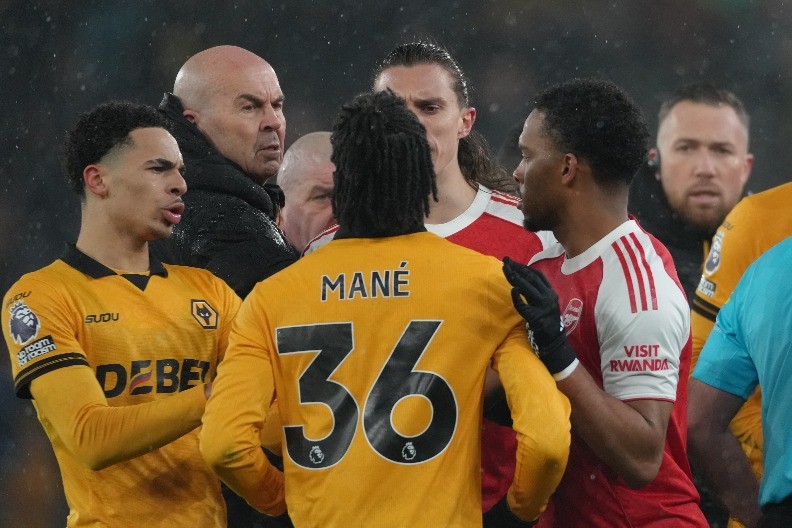
Arsenal drew 2-2 away to Wolverhampton in a Premier League match described as part of the 27th round, with all sources agreeing that Arsenal surrendered a 2-0 lead late in the game. Bukayo Saka opened the scoring for Arsenal in the fifth minute, and the visitors doubled their advantage early in the second half before Wolves responded through Hugo Bueno and a stoppage-time equalizer deep into added time. Coverage concurs that one of Wolverhampton’s goals and one of Arsenal’s goals came via own goals, though there is some inconsistency over which players were credited, and that the dramatic late equalizer arrived around the 94th minute. All outlets agree that the result has direct implications for the title race, as it allowed Manchester City to close the gap at the top, and that Arsenal’s failure to close out a winning position is the defining feature of the match report.
The shared context in both opposition and pro-government reporting frames the match within Arsenal’s broader title challenge and the pressure of the winter period in the Premier League campaign. Both sides recognize that Arsenal remain league leaders on 58 points after this round, while Wolverhampton sit at the bottom of the table with 10 points, making the dropped points particularly costly for a title contender against the last-placed side. Reports emphasize that the fixture forms part of a congested schedule in which maintaining momentum is crucial, and that even a single result can shift psychological and mathematical dynamics in the race with Manchester City. There is agreement that late defensive lapses and high-stakes pressure, rather than refereeing controversy or off-field issues, are the primary immediate causes of the draw, and that the game will likely be revisited as a key moment if the title is ultimately lost or narrowly won.
Points of Contention
Framing of the collapse. Opposition-aligned sources are likely to cast the 2-2 draw as symptomatic of deeper structural frailties, portraying the blown 2-0 lead as evidence that the team and management have not addressed recurring mental and tactical lapses in decisive moments. Pro-government outlets instead emphasize the match as an isolated bad night within an otherwise strong season, underscoring that Arsenal still top the table and suggesting that such slips are part of the natural volatility of a long campaign.
Allocation of responsibility. Opposition coverage tends to spread blame broadly, criticizing defensive organization, in-game management, and the manager’s substitutions, arguing that the coaching staff failed to adjust once Wolves gained momentum. Pro-government coverage, by contrast, narrows responsibility to individual errors such as the late own goal, treating them as unfortunate lapses rather than systemic flaws, and often stresses that the overall game plan had worked for most of the match.
Impact on the title race. Opposition voices are inclined to dramatize the draw as a potentially decisive turning point that could “cost Arsenal the title,” invoking the late equalizer as emblematic of a team that cannot finish the job under pressure. Pro-government sources acknowledge the setback but frame it as a temporary stumble, highlighting the remaining fixtures and the small points margin, and insisting that the title race remains firmly in Arsenal’s hands if they respond positively.
Assessment of mentality and form. Opposition-aligned outlets typically interpret the result as confirmation of a worrying winter slump, stressing a fragile mentality that reappears at the first sign of adversity and warning that confidence may erode quickly. Pro-government reporting, meanwhile, presents the draw as a wake-up call rather than a crisis, arguing that the team’s overall trajectory and league position prove resilience, and suggesting that the late setback can galvanize rather than undermine dressing-room belief.
In summary, opposition coverage tends to depict the draw as a revealing collapse that exposes enduring weaknesses and threatens to derail the title chase, while pro-government coverage tends to normalize the setback as an unlucky but recoverable slip by a still-leading side whose broader campaign remains on track.
Story coverage