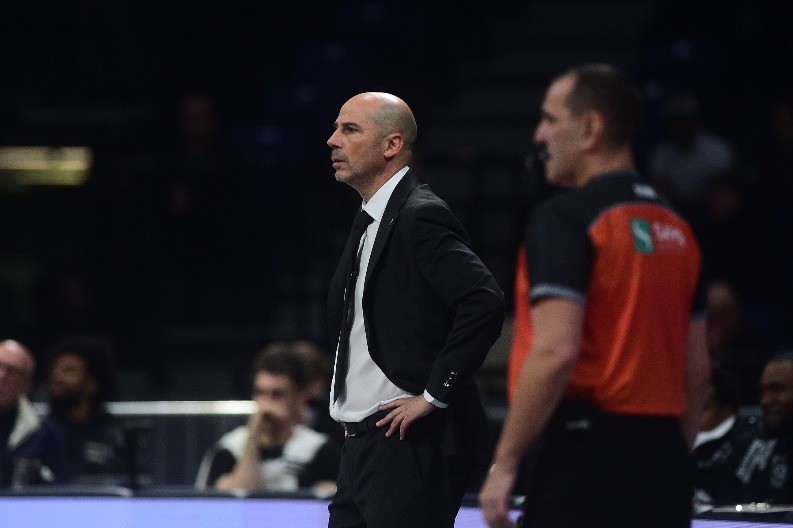


Coach Joan Peñarroya is reported across outlets as having expressed satisfaction after Partizan’s convincing 98:82 win over Budućnost at the start of the ABA League playoffs, stressing that his team controlled the game’s rhythm and deserved the victory. Both sides highlight that he singled out Aleksa Radanov’s performance as especially important, framing the game as a key moment for the player and for the contribution of domestic players, and they agree that Peñarroya confirmed Cameron Payne has recovered from injury and is ready to return to action. All accounts also note that he has not yet decided which four foreign players will be registered for the Radivoj Korać Cup, leaving that selection open.
The coverage converges on contextual points about Partizan’s ambitions in the ABA League playoffs and the upcoming Radivoj Korać Cup, presenting the Budućnost win as an early but meaningful step in a broader campaign. Media from both camps place Peñarroya’s comments within the ongoing emphasis on building a balanced roster that blends impactful foreign signings with reliable domestic players, and they recognize Radanov’s display as part of that strategic push. They also describe Payne’s return from injury as a potentially significant boost for Partizan’s guard rotation at a critical phase of the season, with the coach’s cautious approach to Cup roster decisions framed as standard competitive management rather than controversy.
Points of Contention
Framing of the victory. Opposition-aligned sources tend to describe the Budućnost win as routine for a financially dominant club, portraying Peñarroya’s satisfaction as expected given Partizan’s structural advantages and sometimes downplaying the strategic nuance of “controlling the rhythm.” Pro-government outlets instead cast the result as a statement performance at the start of the playoffs, emphasizing tactical discipline and team cohesion to underscore the coach’s competence. Where opposition narratives might subtly imply that such wins are the minimum required, pro-government narratives present them as evidence that the current sporting project is on the right track.
Significance of Radanov’s role. Opposition coverage is likely to treat the praise for Aleksa Radanov as a narrow, player-focused talking point, questioning whether one strong outing meaningfully shifts the team’s dependence on high-paid foreigners. Pro-government media spotlight Radanov as a symbol of successful development of domestic talent, echoing Peñarroya’s emphasis on local players’ importance and linking it to a broader narrative of national basketball strength. The former can frame his performance as a welcome but isolated positive, while the latter often elevates it into proof of a healthy, well-managed roster policy.
Narrative around Payne’s return. Opposition-aligned outlets may mention Cameron Payne’s readiness to play mainly as a factual injury update, occasionally hinting that Partizan’s heavy investment in foreign stars creates pressure for immediate impact and raises questions about long-term planning. Pro-government coverage tends to present Payne’s recovery as a major reinforcement, underlining the coach’s careful management of his minutes and pointing to the club’s ability to attract and integrate high-caliber players. Thus, one side uses Payne’s return to gently probe sustainability and priorities, while the other uses it to highlight strength in depth and professional medical and coaching structures.
Cup roster decisions. Opposition media often interpret Peñarroya’s comment that he has not yet chosen the four foreigners for the Radivoj Korać Cup as a sign of lingering uncertainty or internal competition, implying that the squad hierarchy is still not fully settled. Pro-government outlets, by contrast, frame the undecided Cup roster as healthy competition and deliberate strategy, stressing that late decisions allow the staff to reward current form and adapt to opponents. Where opposition coverage might suggest potential locker-room tension or favoritism concerns, pro-government narratives portray the same ambiguity as flexibility and a sign of strong depth.
In summary, opposition coverage tends to treat Peñarroya’s remarks as routine, using them to question structural advantages, depth strategy, and reliance on foreigners, while pro-government coverage tends to frame the same comments as evidence of smart roster management, the rise of domestic contributors like Radanov, and the timely strengthening of the team through Payne’s return.
Story coverage