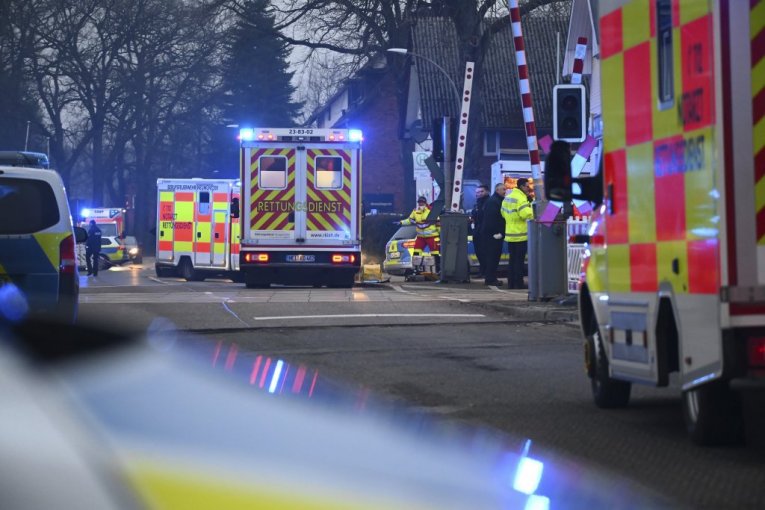
A fire broke out at the Sophienhof shopping center in Kiel, Germany, prompting a large emergency response involving firefighters and police who sealed off the surrounding neighborhood. Across the board, coverage agrees that the blaze originated inside the shopping complex, that several people were initially reported as missing or unaccounted for in the affected building, and that the exact cause of the fire is not yet known. Reports concur that search and rescue operations took place alongside fire suppression efforts and that authorities treated the situation as a serious incident with potential casualties.
Common contextual reporting describes Sophienhof as a central urban shopping hub, making the fire both a public-safety event and a disruption to city life in Kiel. Coverage notes the presence and coordination of standard German emergency institutions such as the fire brigade and police, as well as the use of cordons and evacuations as routine protocol in such incidents. Outlets also agree that, at the time of initial reporting, investigators had not established whether the fire stemmed from an accident, technical fault, or human factor, and that further information would depend on ongoing forensic and safety inspections of the site.
Points of Contention
Scale and severity. Opposition-aligned outlets tend to emphasize the fire as part of a broader pattern of domestic safety or infrastructure problems, often stressing worst-case implications even when details are incomplete. Pro-government outlets, by contrast, highlight the drama and urgency but are careful to frame it as a contained local emergency, avoiding speculation about extensive casualties or systemic failures. While opposition coverage would likely underline missing persons as evidence of grave risk and possible institutional shortcomings, pro-government coverage stresses the efficiency of the response and the lack of confirmed information on fatalities.
Institutional performance. Opposition coverage usually frames such incidents as tests of the competence of emergency services and regulatory oversight, questioning whether building codes, inspections, and preparedness were adequate at Sophienhof. Pro-government outlets instead spotlight the rapid deployment of a large number of firefighters and police, presenting the cordoning off of the neighborhood as proof that authorities acted decisively and professionally. Where opposition voices might scrutinize delays, communication gaps, or prior warnings, pro-government reports focus on reassuring narratives about order, control, and adherence to protocol.
Causation and systemic context. Opposition-aligned sources are more inclined to link the unknown cause of the fire to broader systemic issues, such as underinvestment in maintenance, regulatory laxity, or wider governance failures, and may push for inquiries or political accountability. Pro-government outlets, however, keep the cause firmly in the realm of technical investigation, stressing that no evidence yet points to negligence or structural mismanagement. While opposition coverage might treat the incident as symptomatic of deeper problems, pro-government reporting resists such extrapolation and urges patience until official findings are released.
Framing alongside other crises. Opposition coverage could position the Kiel fire within a narrative of accumulating crises, drawing parallels to other domestic or international incidents to argue that authorities are overstretched or distracted. Pro-government outlets, in the example provided, juxtapose the mall fire with the separate refinery fire in Havana and Cuba’s energy crisis, but use this mainly to underscore the global nature of emergencies rather than to criticize German institutions. Thus, opposition media are more likely to weave the event into a critique of current governance, while pro-government media use comparisons to contextualize, not politicize, the incident.
In summary, opposition coverage tends to treat the Sophienhof fire as a potential symptom of broader institutional or governance shortcomings that warrant political scrutiny, while pro-government coverage tends to stress the competence of emergency responders, minimize speculation, and frame the event as a serious but localized incident best understood through official updates.