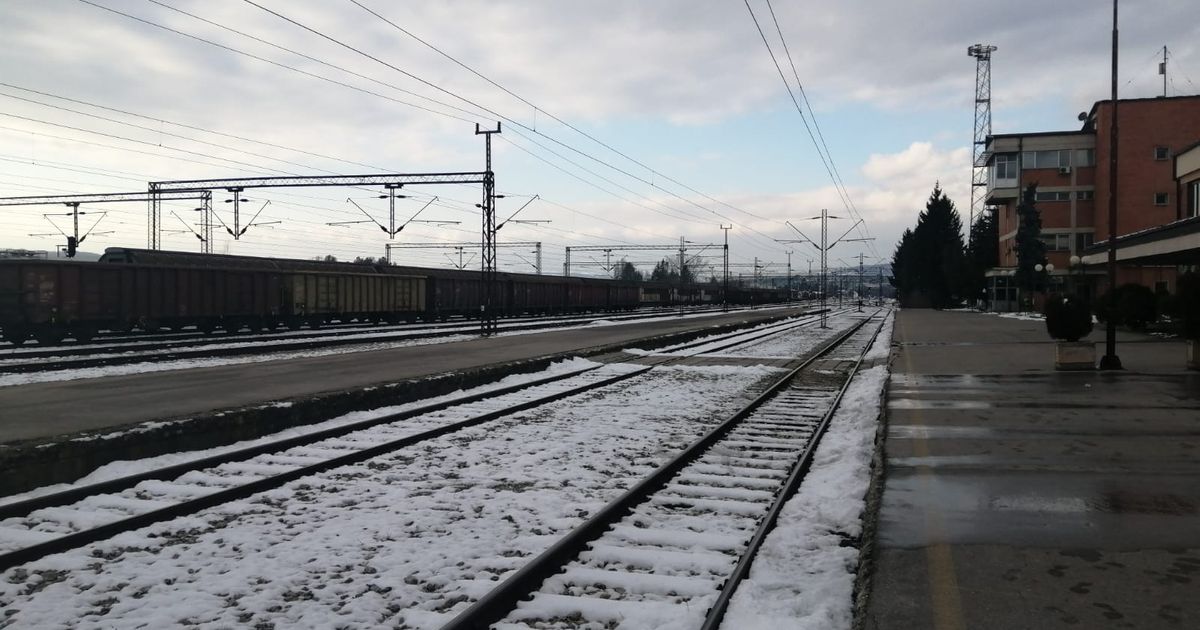
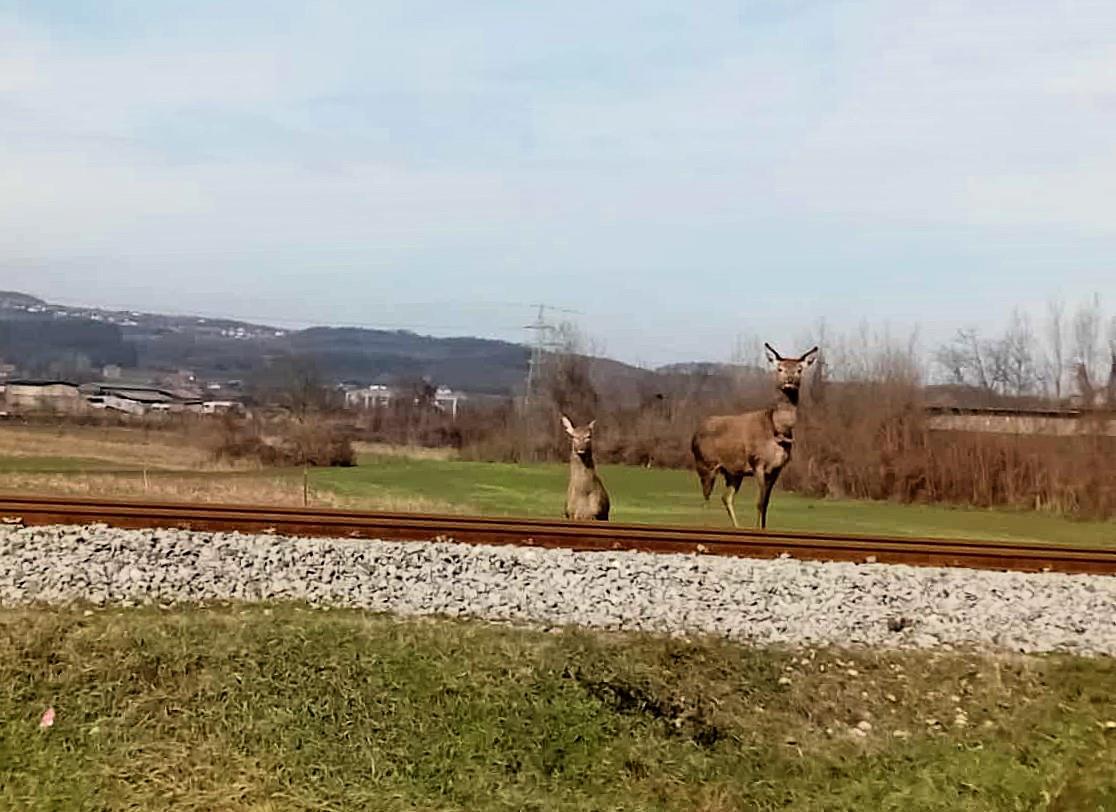
Six hinds were seen in the Loznica area crossing a railway line and a main road near the former "Viskoza" factory, in the broader vicinity of Banja Koviljača. Both sides, where they report on the incident at all, agree that the animals appeared in broad daylight, calmly moved across the tracks and the road, briefly paused, and were photographed at close range before heading toward the Gučevo forest area. The eyewitness, Jelena Nikolić, captured several striking photos as the animals emerged from the direction of the Drina river, traversed agricultural land, crossed the railway and the road, and then continued into an industrial or factory compound on their way to the nearby forested slopes.
Coverage that references this episode also shares a basic contextual frame that this is an unusual but not entirely isolated sight in this specific stretch near Loznica, where deer and hinds have previously been observed crossing the railway. Reports accept that the animals likely came from the Drina river area and were instinctively moving toward the Gučevo forest as part of their natural patterns. There is shared acknowledgment that the incident took place near recognizable local landmarks—Banja Koviljača, the former Viskoza complex, the railway corridor—and that the event was noteworthy mainly because of the number of animals, the midday timing, and the rare opportunity to see such large hinds so close to human infrastructure.
Points of Contention
Framing and significance. Opposition-aligned sources, when they pick up the story, tend to frame the sighting as a curiosity that indirectly highlights encroachment on wildlife habitats and broader negligence in spatial and environmental planning, using the images more as a backdrop for systemic critique. Pro-government outlets instead stress the spectacle and emotional appeal of the photos, treating the event as a feel-good, almost tourist-style story that showcases the "untouched nature" around Loznica and Banja Koviljača. While opposition coverage, where it appears, uses the same facts to raise questions about how close wildlife is forced to come to railways and roads, pro-government coverage emphasizes wonder, uniqueness, and local pride.
Safety and infrastructure. Opposition-leaning reporting is more likely to pivot from the hinds’ crossing to concerns about traffic and railway safety, hinting that such crossings expose persistent gaps in protective fencing, warning systems, and coordinated wildlife corridors. Pro-government media mention the railway and road chiefly as scenery, downplaying or omitting any discussion of risk to drivers, train operators, or the animals themselves. In opposition narratives, the same scene becomes a case study illustrating how infrastructure modernization and environmental safeguards lag behind standards, whereas pro-government pieces present it mainly as an innocuous, picturesque episode.
Environmental and policy implications. Opposition coverage tends to connect the sighting, at least implicitly, to shrinking natural habitats, unregulated construction, and policies around industrial zones like the former Viskoza complex, implying that animals are increasingly pushed into human spaces. Pro-government outlets generally avoid linking the event to policy debates, portraying the movement of the hinds as a natural migratory or roaming behavior between the Drina and Gučevo, thereby sidestepping questions about land use, zoning, or environmental governance. Thus, for opposition media the same images can serve as soft evidence for criticizing development models, while pro-government media keep the focus narrow and apolitical.
Use of eyewitness voice. Opposition-aligned sources, when they reference Nikolić’s testimony, are more inclined to minimize her institutional role and instead emphasize her surprise as an ordinary citizen, weaving her quotes into a broader critical narrative about everyday encounters with wildlife near risky infrastructure. Pro-government reporting foregrounds that she works for a local public company and highlights her astonishment mainly to boost the story’s human-interest and local-institutional credibility, without extending her comments into any critique. In this way, opposition media use the same witness voice more as a jumping-off point for systemic questions, while pro-government media use it to strengthen the impression of a charming, well-documented local anecdote.
In summary, opposition coverage tends to treat the hinds’ crossing as a visually striking example that can be folded into larger concerns about habitat loss, infrastructure safety, and local development policy, while pro-government coverage tends to present it as an uplifting, depoliticized story of nature coexisting with people and as a promotional vignette for the Loznica–Banja Koviljača area.