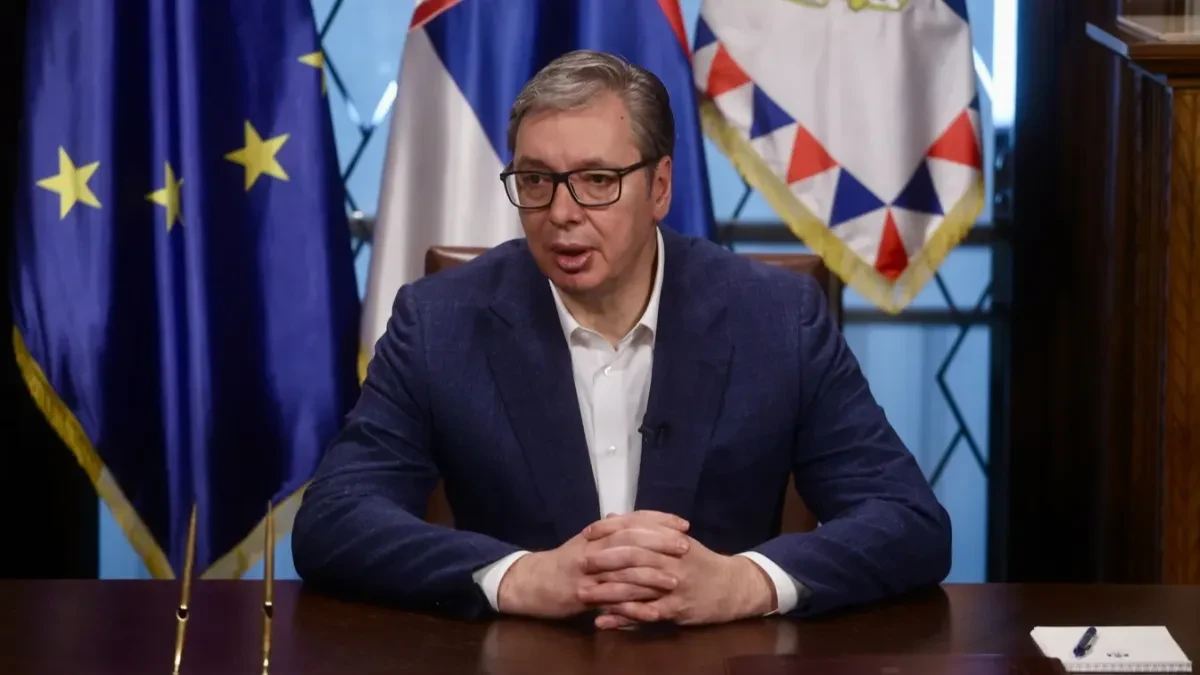
Serbian President Aleksandar Vučić has announced that he will initiate talks within the Serbian Progressive Party and with other political parties and actors on two main topics: upcoming elections in Serbia and the country’s foreign policy direction. Both opposition- and pro-government–aligned sources agree that formal consultations have been called, that party representatives have been invited, and that the first meetings are scheduled to start imminently, including at a clearly specified time in Belgrade. Coverage on both sides notes that the initiative is framed as a broad political dialogue, encompassing a wide spectrum of parties, with some opposition groups such as the Democratic Party and the Green-Left Front publicly stating that they will not attend and reiterating their pre-existing electoral demands and positions.
Across the spectrum, outlets acknowledge that these talks are occurring against a backdrop of strong polarization, recent local elections, and mounting debate over Serbia’s international alignment, particularly its relationship with the European Union and responses to alleged election-related violence. Sources concur that state institutions like the presidency and the National Assembly leadership are central in convening and shaping the dialogue, and that the stated purpose is to address both domestic political stability and Serbia’s positioning in a changing global environment. There is also shared recognition that questions of international law, external pressure, and long-term strategic orientation are being bundled into the same political process as any decision on early or snap elections, with all actors presenting the dialogue as consequential for the country’s future trajectory.
Areas of disagreement
Nature and purpose of the dialogue. Opposition-aligned commentary portrays Vučić’s initiative as a control mechanism aimed at preserving his grip on power, suggesting that talks framed as national dialogue do not address core issues of electoral integrity and institutional imbalance. Pro-government outlets, by contrast, depict the process as a genuine, even historic, effort to open society-wide discussions on elections and foreign policy, emphasizing the president’s willingness to talk with all actors, including those who have harshly criticized or even threatened him. While the opposition side tends to question the sincerity and timing of the invitation, pro-government coverage stresses inclusiveness and responsibility in the face of internal divisions and international pressures.
Elections and political normalization. Opposition perspectives argue that new elections under current conditions would not lead to true normalization, warning that without fundamental changes in the media environment, electoral rules, and accountability, further voting could deepen the crisis. Pro-government sources counter that refusing to join the talks signals that some opposition parties are interested only in escalation and delegitimization, not in constructive solutions. In this framing, early or snap elections are considered a legitimate instrument to stabilize the situation, provided they emerge from the announced consultations rather than street pressure or foreign demands.
Role of the European Union and external actors. Opposition-linked analysis tends to treat EU concerns about election violence and irregularities as broadly grounded, part of a necessary external check on a captured domestic system, and a factor that should push Serbia closer to European norms. Pro-government outlets instead describe a “new series of untruths” coming from certain EU circles, characterizing these narratives as pressure and interference in Serbia’s internal affairs designed to weaken the current leadership. While opposition voices lean on external criticism to underscore systemic problems at home, pro-government coverage frames the same foreign reactions as politically motivated attacks that reinforce the need for national unity around Vučić’s agenda.
Accountability and responsibility for tensions. Opposition-oriented coverage implicitly or explicitly holds the ruling party responsible for deep polarization and for conditions that make genuine dialogue difficult, pointing to past episodes of violence, intimidation, and institutional degradation as reasons for skepticism. Pro-government media invert this responsibility, arguing that opposition parties that refuse consultations “do not want dialogue, only destruction,” and that they exploit claims of violence and irregularities to delegitimize any outcome they do not win. Thus, where the opposition sees boycotts and refusals as principled resistance to an unfair playing field, pro-government outlets portray them as evidence of bad faith and fear of facing voters.
In summary, opposition coverage tends to cast Vučić’s dialogue initiative as a tactical move to deflect international criticism and avoid substantive reforms before any new elections, while pro-government coverage tends to present it as a responsible and inclusive effort to confront unfair foreign pressure, calm domestic tensions, and chart Serbia’s electoral and foreign policy course through institutional talks.