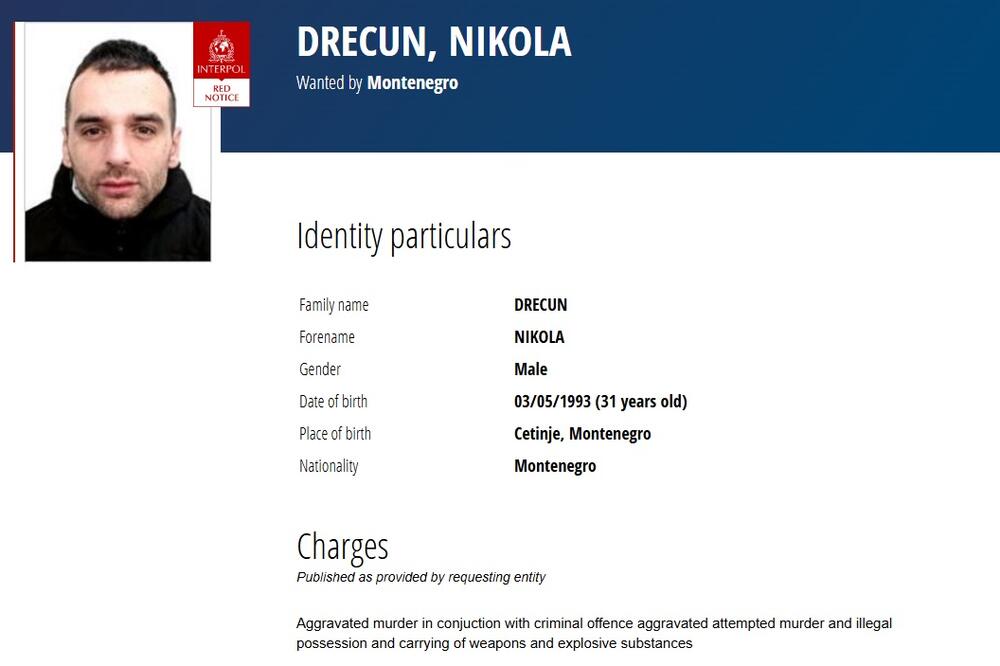
The available coverage agrees that the Higher State Prosecutor's Office in Podgorica has filed an indictment against Nikola Drecun and Predrag Mirotić for the killing of two men, Stefan Belada and Andrija Ivanović, in Cetinje. Media on both sides report that Drecun is a fugitive allegedly linked to the Kavač criminal clan, that the victims are described as connected to the rival Škaljari clan, and that the attack was carried out from ambush with around 47 shots fired, after the movements of the victims were tracked with a GPS device. There is also consensus that the indictment connects this case to earlier serious crimes involving Drecun, and that investigators are working under the auspices of the Higher State Prosecutor, following standard criminal procedure.
Both opposition and pro-government narratives acknowledge that the case is situated within Montenegro's broader struggle with organized crime and the long-running Kavač–Škaljari conflict, which has produced a series of murders and attacks in recent years. They also concur that the institutions formally in charge of the case are the Higher State Prosecutor's Office and the police, and that the indictment is part of ongoing efforts to confront mafia-style violence and clarify links among criminal groups, prior attacks, and potential political or institutional ties. There is shared recognition that the investigation has triggered additional institutional checks, including a separate case to verify allegations connected to explicit videos involving former official Mirjana Pajković, signaling possible overlap between criminal networks and segments of the public sector.
Areas of disagreement
Framing of institutions. Opposition-aligned sources tend to question whether the Higher State Prosecutor's Office and police are acting independently and thoroughly, often hinting that parts of the security and justice apparatus may still be compromised by clan influence. Pro-government outlets, by contrast, usually describe the indictment as proof that state institutions are functioning, highlighting the professionalism of prosecutors and investigators and emphasizing that no one tied to powerful clans is beyond the reach of justice. While opposition coverage is more likely to portray the case as a test that the institutions may be failing, pro-government media present it as evidence that reforms and current leadership are delivering results.
Political responsibility and legacy. Opposition reporting generally links the double murder and Drecun's alleged activities to a broader legacy of state capture and corruption by past ruling structures, suggesting that long-term collusion between officials and criminal clans enabled such violence. Pro-government narratives, however, tend to distance current authorities from that legacy, framing the case as part of a cleanup of problems inherited from previous governments and focusing blame on prior elites or "old structures" rather than the present leadership. Where opposition voices may argue that the political establishment as a whole bears responsibility, pro-government outlets stress a break with the past and portray the current government as the solution rather than the cause.
Sensational details and personal ties. Opposition-leaning media are more likely to scrutinize alleged connections between Drecun and public officials, treating elements such as the explicit videos case involving former official Mirjana Pajković as signs of entrenched networks that blur lines between politics, crime, and scandal. Pro-government outlets also report these elements but often package them in more sensationalistic, tabloid-style terms, using them to individualize blame and underscore the moral depravity of specific figures rather than systemic issues. Thus, opposition coverage uses such details to argue for structural reform and transparency, while pro-government coverage uses them to isolate a few compromised individuals and reinforce the narrative that the system is now cleansing itself.
Interpretation of the clan conflict. Opposition sources typically frame the Kavač–Škaljari rivalry as a symptom of deeper governance failures, underscoring how years of weak rule of law allowed these organizations to grow and infiltrate institutions. Pro-government media tend to stress the brutality of the clans themselves and the risks they pose to public security, highlighting police and prosecutorial operations as a robust response without dwelling as much on how those groups gained power. While opposition narratives stress state complicity or negligence as the root cause, pro-government narratives stress law-enforcement activism and the inherent criminality of the clans as the central story.
In summary, opposition coverage tends to use the indictment as a lens to question institutional integrity, historical complicity, and the depth of ongoing reforms, while pro-government coverage tends to emphasize the effectiveness of current authorities, personalize blame to specific actors and clans, and frame the case as proof that the state is finally confronting organized crime.