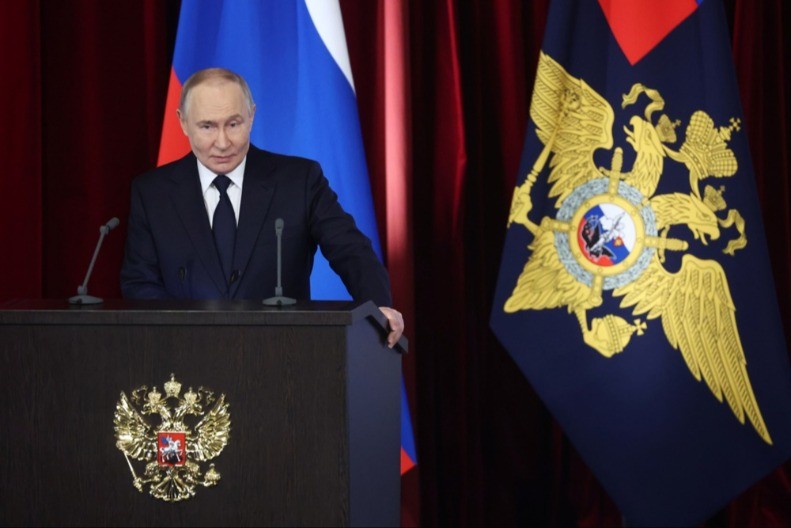

Russian President Vladimir Putin has signed a federal law limiting the administrative expulsion of foreign citizens and stateless persons who have served under contract in the Russian Armed Forces and taken part in military tasks. Coverage agrees that, for this specific category of foreigners, deportation will largely be replaced by other administrative penalties such as fines, compulsory labor, and possible bans on attending sports events for up to several years, even in cases where their actions would ordinarily trigger expulsion. Both sides report that the measure modifies existing rules on administrative offenses and applies on Russian territory, and that it sits within a broader framework of policies aimed at managing foreign nationals involved in Russia’s military activities.
Outlets across the spectrum describe the law as part of Russia’s ongoing effort to regulate the legal status of foreign fighters and to formalize incentives for foreigners to serve in the Russian army. There is shared acknowledgment that Russian law has been incrementally adjusted since the start of the full-scale war in Ukraine to make military service more attractive to non‑citizens, including fast‑track naturalization and special protections from removal. Both opposition and pro‑government coverage situate this change within existing institutions of migration control and military contracting, noting that the measure interacts with standard administrative sanctions rather than criminal law, and that it reflects Moscow’s continuing reliance on foreign recruits to supplement its armed forces.
Areas of disagreement
Purpose and motivation. Opposition-aligned outlets portray the law as primarily a wartime expedient meant to secure a steady supply of foreign manpower for the conflict in Ukraine and as evidence of mounting recruitment pressures, while pro-government media frame it as a logical extension of state support and legal guarantees for those who have fulfilled their military duty. Opposition sources emphasize that by shielding foreign soldiers from expulsion, the Kremlin is effectively offering legal impunity to attract and retain fighters who might otherwise be reluctant to sign contracts. Pro-government narratives instead stress gratitude to foreign servicemen and the state’s obligation not to abandon them to deportation after they have risked their lives.
Security and legal risks. Opposition coverage underscores the potential domestic security implications of keeping foreigners who have committed administrative offenses inside Russia, warning that some may have combat experience, possible criminal backgrounds, or limited integration into Russian society. Pro-government outlets, by contrast, downplay such risks and highlight that administrative penalties like fines, compulsory labor, and event bans remain available, arguing that the law merely calibrates punishment rather than removing accountability. While opposition voices raise concerns about creating a privileged class of foreign fighters who are harder to remove, pro-government reports largely present the measure as a narrowly tailored exception that is consistent with existing law-and-order principles.
Human rights and accountability. Opposition sources tend to link the reform to broader allegations of Russia using vulnerable migrants and foreign nationals as cannon fodder, suggesting that offering protection from expulsion may pressure them into contracts and weaken mechanisms to hold them responsible for misconduct. Pro-government coverage instead depicts the law as a humane measure that protects veterans from what it portrays as a disproportionate sanction, arguing that expulsion after service would be unfair and destabilizing for individuals who may have built lives in Russia. In this framing, opposition concerns about accountability are cast as politicized critiques that ignore the legal safeguards still in place.
International and diplomatic framing. Opposition-oriented outlets often situate the law within Russia’s deteriorating international reputation, warning that formalizing protections for foreign fighters involved in the Ukraine war could increase scrutiny from foreign governments and human-rights bodies. Pro-government media tend to avoid or minimize this external dimension, presenting the change as an internal sovereign decision and occasionally suggesting that it may even strengthen ties with partner states whose citizens serve in the Russian army. Where opposition coverage hints at possible future legal or diplomatic fallout, pro-government accounts focus on reinforcing Russia’s image as a state that honors and protects those who fight on its side.
In summary, opposition coverage tends to frame the law as a wartime tool that trades accountability and security for foreign manpower and deepens Russia’s dependence on migrant fighters, while pro-government coverage tends to portray it as a limited, humane adjustment that honors foreign servicemen, preserves public order through alternative penalties, and asserts Russia’s sovereign right to regulate the status of those who fought in its armed forces.