
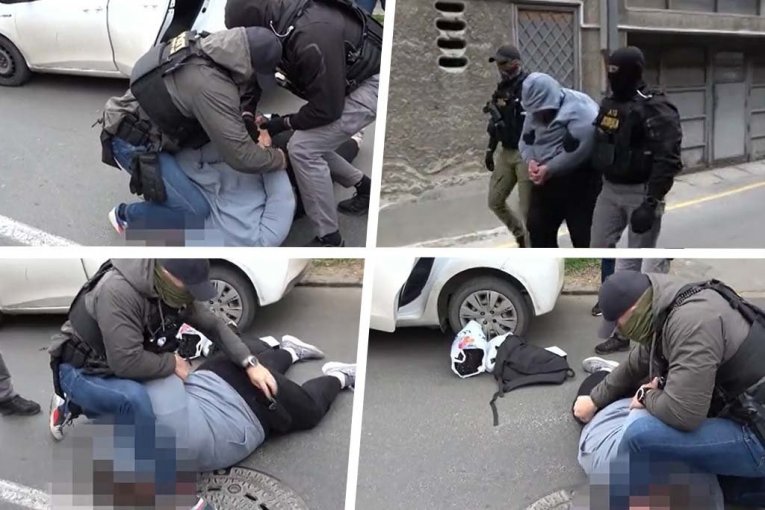
A 24-year-old man identified as B.K. has been arrested in Belgrade on suspicion of throwing a hand grenade at a catering venue, described in some reports as a beer restaurant, in Zemun on March 17, damaging the facade and windows but without reported casualties. Both opposition and pro-government-leaning outlets agree that the police tracked him down and detained him in the street, and that in a separate but contemporaneous action officers arrested three additional suspects, R.C. (34), F.S. (24) and J.V. (39), for allegedly setting fires at a restaurant in the Palilula municipality on February 25 and March 3; all detained individuals have been placed in custody for up to 48 hours and are to be brought before the competent public prosecutor’s offices.
Across the spectrum, media acknowledge that the case falls under the remit of the Belgrade police and local public prosecutors, and is being treated as a serious threat to public safety and property rather than as a minor disturbance. Outlets generally situate the incident within a broader pattern of violent attacks on businesses in Belgrade’s neighborhoods, sometimes linked to disputes in the hospitality sector and local criminal circles, and they concur that swift procedural steps—identification, arrest, short-term detention, and referral to prosecutors—followed standard criminal-justice protocols intended to reassure the public and signal institutional responsiveness.
Areas of disagreement
Framing of the incident. Opposition-aligned sources tend to frame the grenade attack as part of a worrying trend of escalating urban violence and insecurity in Belgrade, using it as an illustration of deeper systemic problems in policing and crime prevention, while pro-government outlets describe it primarily as a spectacular but successfully resolved police operation. While opposition coverage often stresses that such an attack could have had mass-casualty consequences and underscores citizens’ fear, pro-government media emphasize the lack of injuries and focus on material damage and the technical details of the arrest. The result is that the same facts are cast either as evidence of a city sliding into lawlessness or as proof that the security services are fully in control.
Assessment of police and state performance. Opposition media typically question why a grenade attack on a public venue could occur in the first place, suggesting that rising crime stems from political protection of criminal structures and chronic underinvestment in preventive policing, whereas pro-government outlets present the rapid identification and arrest of suspects as a success story for the police and interior ministry. In opposition narratives, the case is used to argue that institutions react only after publicized incidents, sometimes under external pressure, indicating weakness or politicization. Pro-government coverage instead highlights operational efficiency, forensic work, and coordination with prosecutors, portraying institutions as professional, apolitical, and effective.
Political implications and responsibility. Opposition-oriented reporting often draws a direct or indirect line from this attack to the broader political climate, arguing that a culture of impunity fostered by the ruling party has normalized weapons, intimidation, and attacks on businesses, while pro-government media usually avoid explicit political links and treat the suspect as an isolated criminal actor. Critics leverage the case to talk about alleged ties between party structures and underworld figures, framing the grenade attack as a symptom of captured institutions, whereas loyalist coverage either omits such angles or dismisses them as opposition spin that exploits a criminal case for partisan gain. This divergence shapes whether audiences see the event as politically meaningful or strictly criminal.
Discussion of reforms and solutions. Opposition sources tend to use the incident to call for deeper reforms such as depoliticizing the police, tougher oversight of illegal weapons, and transparent investigations into links between officials and organized crime, while arguing that current measures are cosmetic. Pro-government outlets, by contrast, cite the swift arrests as evidence that recently introduced security policies, raids, and legal amendments are working, framing further changes in terms of incremental strengthening rather than systemic overhaul. Where opposition discourse stresses the need for independent institutions and accountability at the top, pro-government narratives focus on operational tweaks and continued support for existing leadership.
In summary, opposition coverage tends to present the grenade attack in Zemun as a symptom of broader systemic failures, politicized institutions, and a deteriorating security climate, while pro-government coverage tends to emphasize the efficiency of the police response, frame the case as an isolated criminal act, and use it as proof that current state security policies are functioning effectively.