

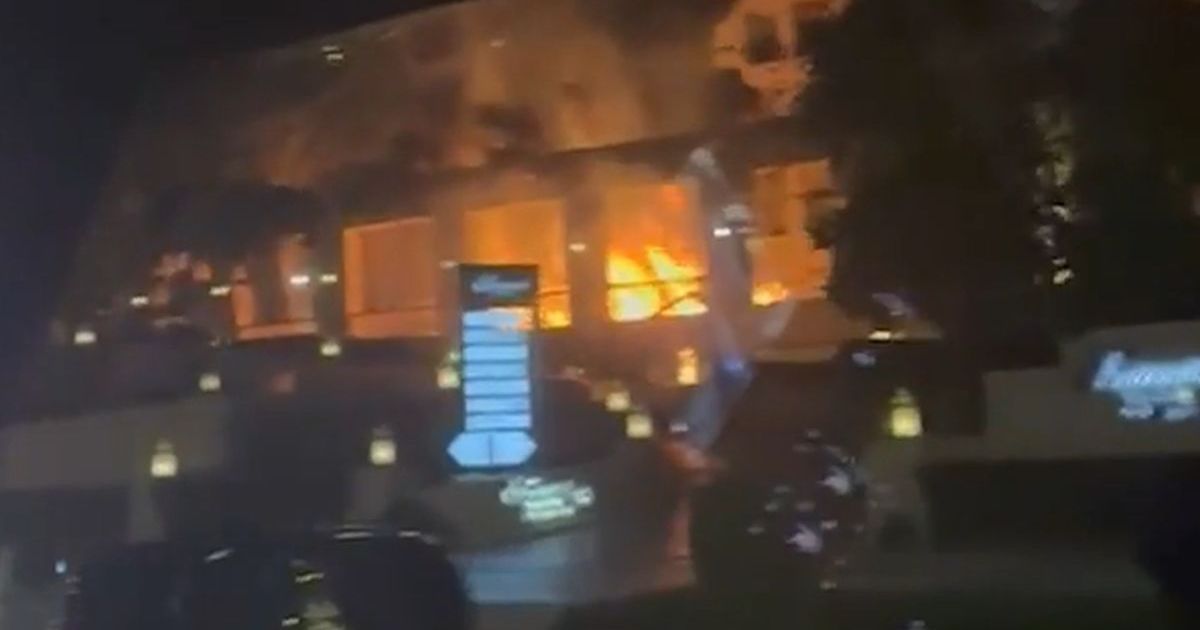
A drone struck the upper floors of the Al-Rashid Hotel in central Baghdad, causing a large explosion and fire in a building known to host the European Union mission and several European and other foreign diplomatic representations. Coverage from both opposition and pro-government oriented media agrees that the attack involved a single unmanned aerial vehicle impacting an upper level of the hotel, that dramatic footage showed flames and heavy smoke, and that the incident heightened immediate security concerns for foreign personnel stationed there. Reports concur that the strike took place against a backdrop of already elevated regional tensions and that emergency services responded as fire engulfed part of the structure.
Across the spectrum, outlets situate the incident within broader regional instability involving Iran, the United States, Israel, and ongoing conflicts linked to Iran’s nuclear program and wider proxy confrontations. There is also agreement that the hotel’s role as a hub for EU and other foreign diplomatic missions makes the attack symbolically significant and potentially damaging to Iraq’s image as it attempts to normalize relations and attract international engagement. Media on both sides reference Iraq’s current efforts to revive strategic oil export routes, including the Kirkuk-Ceyhan pipeline toward Turkey, and acknowledge that such infrastructure and diplomatic sites are increasingly exposed to spillover from regional power struggles.
Areas of disagreement
Responsibility and blame. Opposition-aligned sources generally emphasize Iraqi government weakness and possible complicity or negligence, speculating about local militias or regional proxies operating with impunity, while pro-government outlets avoid firm attributions and frame the attack more vaguely as part of a regional escalation. Pro-government coverage often highlights the wider confrontation between Iran, the United States, and Israel without clearly linking the strike to actors inside Iraq, whereas opposition coverage tends to foreground domestic armed groups and failures of security policy. This creates a divide between a narrative of internal accountability and one that externalizes the primary drivers of the violence.
Significance for Iraq’s stability. Opposition media tend to cast the incident as evidence that Baghdad remains unsafe even for high-profile diplomatic facilities, portraying the strike as a severe blow to investor confidence and a sign of state erosion. Pro-government outlets, in contrast, stress that the attack, while serious, is an exceptional event against a generally improving security landscape and underscore the rapid response by authorities. As a result, opposition narratives lean toward depicting systemic instability, whereas pro-government narratives stress resilience and continuity.
Implications for foreign relations and diplomacy. Opposition coverage often suggests that foreign partners, including the European Union, may reconsider their presence or downgrade engagement with Iraq due to the inability of security forces to protect them. Pro-government sources, however, underline ongoing cooperation with European states and frame the hotel’s diplomatic role as proof of Iraq’s integration into international diplomacy that adversaries are trying to undermine. The former tends to forecast diplomatic fallout and isolation, while the latter highlights solidarity with foreign missions and insists bilateral and EU ties will endure.
Economic and energy context. Opposition-aligned outlets are more likely to argue that such attacks jeopardize Iraq’s efforts to repair and utilize export infrastructure like the Kirkuk-Ceyhan pipeline, reinforcing a narrative that political capture and militia influence threaten long-term economic planning. Pro-government media, by contrast, present the pipeline revival and diversification of export routes as strategic achievements that will proceed despite attempts at destabilization, using the incident to justify stronger central control over routes that bypass local power centers. This leads to contrasting portrayals of energy policy as either vulnerable and mismanaged or as resilient and strategically guided.
In summary, opposition coverage tends to frame the drone strike as proof of deep state fragility, unaccountable militias, and looming diplomatic and economic fallout, while pro-government coverage tends to situate it within broader regional tensions, stress state responsiveness, and reaffirm the continuity of Iraq’s foreign partnerships and strategic projects.