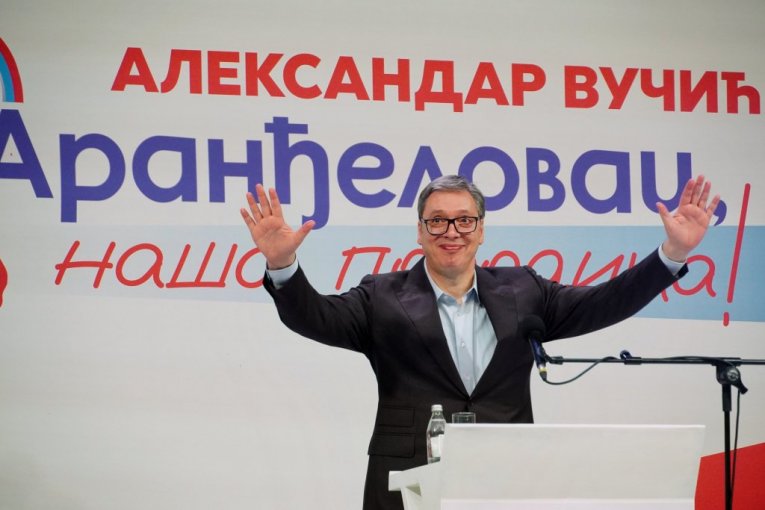
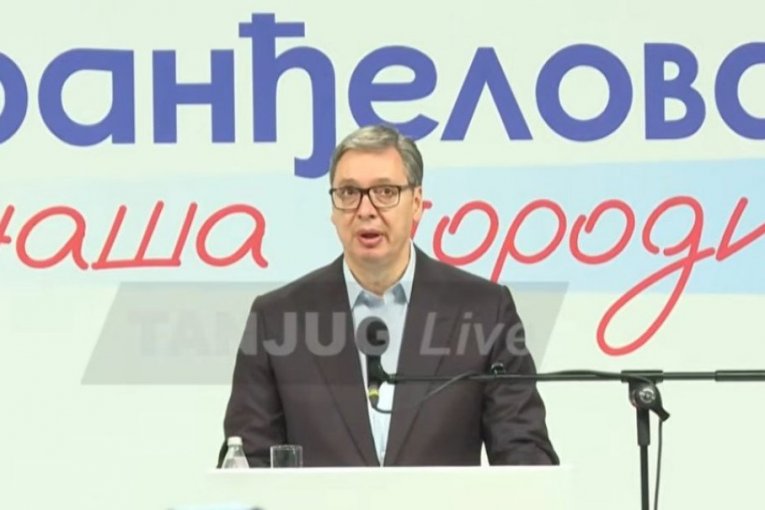
President Aleksandar Vučić held a Serbian Progressive Party rally in Aranđelovac ahead of upcoming local elections, addressing supporters in a packed venue in this Šumadija municipality. Both opposition and pro-government sources agree that he appeared in his dual role as president and party leader, called on citizens to back SNS slates in a broader cycle of local votes across multiple municipalities, and framed the contest as crucial for Serbia’s political direction. Coverage from all sides notes that the event included a highly choreographed stage appearance, strong security presence, and organized transport of supporters from the wider region, and that his speech was broadcast and amplified by national and local outlets.
Across the spectrum, media agree that Vučić used the Aranđelovac rally to talk about economic development, infrastructure projects, and new technologies such as artificial intelligence as pillars of Serbia’s future. They also converge on the fact that he linked local issues with national strategy, highlighting regional investment, tourism potential, and industrial and agricultural development in Šumadija, as well as Serbia’s positioning between larger geopolitical blocs. Both sides acknowledge that he visited local facilities and producers in the area and portrayed the elections as a choice about stability, modernization, and the continued implementation of his government’s development agenda.
Areas of disagreement
Nature of the rally. Opposition-aligned outlets portray the Aranđelovac event as a heavily stage-managed show of power, claiming that attendance relied on pressure on public-sector employees and organized transport, and that it blurred the line between state and party activity. Pro-government media, by contrast, present the rally as a spontaneous, enthusiastic gathering of citizens demonstrating broad support for Vučić and SNS policies. While the opposition stresses what it calls an uneven playing field and misuse of institutional resources, pro-government coverage emphasizes turnout, energy, and the president’s direct engagement with ordinary people.
Campaign messaging and promises. Opposition sources characterize Vučić’s focus on artificial intelligence, infrastructure, and regional development as recycled campaign rhetoric, arguing that many previously announced projects remain unfinished or selectively delivered in politically loyal areas. Pro-government outlets highlight the same themes as evidence of a coherent, long-term modernization strategy, citing new roads, investments, and digital initiatives as proof that promises are being fulfilled. Where opposition media see overpromising and clientelism, pro-government coverage frames the speech as a realistic roadmap that ties local prosperity in Aranđelovac to national growth.
Use of national issues in local elections. Opposition reporting criticizes Vučić for turning a local electoral contest into a referendum on his national leadership, claiming that he instrumentalizes broader questions such as foreign policy, security, and relations with NATO and the region to overshadow local governance problems. Pro-government media defend this framing, arguing that municipal outcomes directly affect Serbia’s overall stability and development trajectory and therefore legitimately warrant national-level themes. The former warns that this approach sidelines debates about local corruption, public services, and urban planning, while the latter contends that only a unified political direction from the top down can secure consistent improvements in communities like Aranđelovac.
Media environment and democratic standards. Opposition outlets use the rally to illustrate what they describe as an increasingly captured media landscape, pointing to blanket live coverage on pro-government channels and limited visibility for alternative lists as signs of structural bias and creeping authoritarianism. Pro-government media instead underscore the president’s accessibility to the press and the live broadcast of his address as transparency, asserting that voters are well informed and free to choose. While opposition coverage frames the event as a symptom of weakened institutions and electoral irregularities, pro-government reporting presents it as a normal, even exemplary, campaign practice in a vibrant democracy.
In summary, opposition coverage tends to depict Vučić’s Aranđelovac rally as an over-centralized, media-dominated spectacle that masks local problems and entrenches unfair electoral conditions, while pro-government coverage tends to present it as a legitimate, future‑oriented demonstration of popular support and a clear vision for regional and national development.