

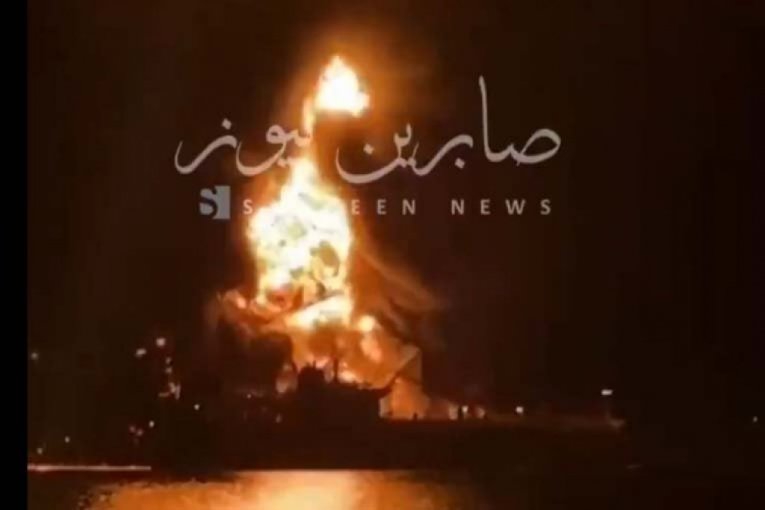
Two oil tankers were reported on fire in Iraqi waters of the Persian Gulf near the port of Basra, with coverage agreeing that at least one vessel was hit by an external impact before the blaze. Reports converge on dramatic scenes of large flames visible from a distance and confirm that rescue teams evacuated around 25 crew members from the burning ships, with no immediate mass-casualty figures announced. Both sides acknowledge that the precise ownership, flag, and cargo details of the tankers remain unclear in early reporting, and that officials have not yet issued a definitive public statement on the cause. The timing is described consistently as a sudden maritime incident in a heavily trafficked oil export corridor, with live or recent video circulating on social media showing the fire.
Shared context across coverage emphasizes that the incident occurred in a strategically sensitive zone close to Iraq’s main oil terminal, in a waterway already known for previous tanker incidents and geopolitical tension. Both opposition and pro-government sources frame the event against a backdrop of regional rivalry involving Iran, Gulf states, and Western powers, where maritime security is a recurring concern. They note that the Persian Gulf’s importance to global energy markets magnifies the political stakes of any disruption or attack, and that past episodes have often triggered rapid speculation about state or proxy involvement. There is also common recognition that investigations into such attacks are typically slow, contested, and shaped by intelligence claims and diplomatic positioning.
Areas of disagreement
Responsibility and blame. Opposition-aligned outlets tend to stress the absence of verified evidence, warning against premature attribution and highlighting that no party has formally claimed responsibility. Pro-government media, by contrast, foreground preliminary suggestions that Iran may be behind the incident and hint that the tankers could be linked to the United States, implicitly aligning the event with an alleged pattern of Iranian aggression. While opposition coverage emphasizes the need for forensic investigation and neutral fact-finding, pro-government narratives lean more heavily on intelligence hints and unnamed sources to frame Iran as the likely culprit.
Framing of the incident. Opposition sources are more inclined to present the fires as part of a broader, ambiguous pattern of maritime insecurity in the Gulf, outlining multiple possible actors and motives, including false-flag scenarios or criminal activity. Pro-government outlets instead dramatize the event with emotive language and video, casting it as a spectacular hostile act that underscores the threat posed by Iran and its allies. The opposition framing is generally cautious and analytic, while pro-government coverage uses sensational imagery and rhetoric to reinforce a narrative of external enemies targeting regional and possibly Western-linked shipping.
Implications for regional politics. Opposition coverage typically raises concerns that fast-moving accusations could be used to justify escalation, sanctions, or tighter security cooperation with Western militaries, and questions whether the government might leverage the incident to consolidate power or distract from domestic problems. Pro-government media often portray the attack as validating a hard line toward Iran and argue that it demonstrates the necessity of strong security services and closer alignment with friendly powers. Where opposition outlets warn of a potential drift toward conflict and securitization, pro-government narratives present the same event as proof that existing security and foreign policy choices are both necessary and vindicated.
Transparency and information control. Opposition-aligned reporting tends to highlight gaps in official statements, pressing for more detail on the ships’ ownership, cargo, and the nature of the strike, and hinting that authorities may be withholding politically inconvenient information. Pro-government sources, however, generally treat official or semi-official briefings as credible and sufficient, focusing less on unanswered questions and more on amplifying the threat narrative and rescue efforts. Thus, the opposition frames information scarcity as a democratic accountability issue, whereas pro-government media normalize limited disclosure as part of an ongoing security investigation.
In summary, opposition coverage tends to treat the tanker fires as a serious but still ambiguous security incident that requires careful verification and restraint, while pro-government coverage tends to depict it as an almost self-evident act of Iranian-linked aggression that reinforces existing hard-line security and foreign policy narratives.
