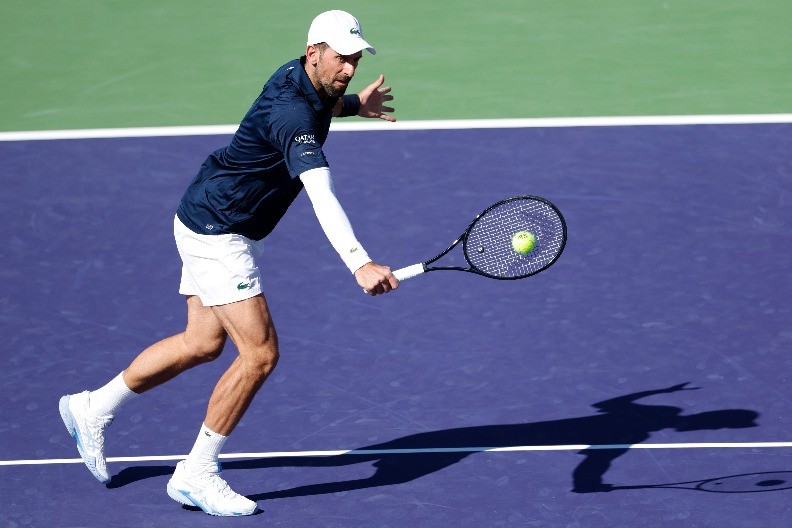


Novak Djokovic defeated Aleksandar Kovacevic in a three-set match at Indian Wells to advance to the round of 16 at the Masters 1000 tournament in California. Both opposition and pro-government sources agree that Kovacevic started strongly and took the first set, largely on the strength of his powerful serve and aggressive play, before Djokovic raised his level to turn the match around. Coverage converges on the description of the encounter as tense and uncertain until late in the decider, emphasizing that Djokovic had to work hard, seize key break opportunities, and rely on his experience to close out the victory against a countryman who surprised many with his level.
Across the spectrum, outlets emphasize Djokovic’s broader historical context at Masters 1000 events, noting that this win pushed him to a record number of round-of-16 appearances, adding to his already unmatched tallies of titles, finals, semifinals, and overall wins at this level. Both sides underline his status as one of the sport’s dominant figures, while also highlighting Kovacevic’s Serbian background, one-handed backhand, and strong serve as markers of a promising player who could rise further. Reports agree that Djokovic spoke warmly of Kovacevic after the match, calling him a close friend and recognizing his improvement, which is framed as part of a wider narrative about the depth of Serbian tennis talent and the generational handover underway on the ATP Tour.
Areas of disagreement
Match narrative and tone. Opposition-aligned outlets tend to stress Djokovic’s vulnerability, framing the match as a near-upset where the world star struggled unusually in early rounds and was put under severe pressure by a lower-ranked compatriot. Pro-government media, by contrast, emphasize Djokovic’s resilience and ability to "switch on" when needed, portraying the early deficit as a temporary lapse and the comeback as evidence of his championship mentality rather than decline.
Emphasis on Kovacevic. Opposition sources are more likely to highlight Kovacevic’s performance as the central story, underlining his strong serving, first-set dominance, and missed chances as indicators that established Serbian tennis structures may be under-serving emerging talents. Pro-government outlets acknowledge his impressive serving and one-handed backhand but keep him mostly in a supporting role, using his performance to reflect positively on Djokovic’s depth of opposition and on Serbian tennis more broadly rather than as a systemic critique.
Use of records and symbolism. Opposition coverage tends to treat Djokovic’s new round-of-16 record as a secondary detail, sometimes juxtaposing it with questions about how long such dominance can last and whether institutional support for tennis will endure. Pro-government reporting foregrounds the record, listing his numerous Masters milestones and presenting the achievement as another national point of pride, tightly linking Djokovic’s success to a narrative of Serbian sporting excellence and continuity.
Political and institutional framing. Opposition-aligned media are more inclined to separate Djokovic’s personal success from the state, hinting that his achievements arise in spite of limited or misdirected sports policy and using the hard-fought nature of the win to argue that systemic reforms are needed to nurture the next generation. Pro-government outlets instead fold the result into a broader story of national progress, presenting Djokovic and the rise of players like Kovacevic as evidence that existing institutions, coaching structures, and national support are functioning effectively and should be celebrated rather than overhauled.
In summary, opposition coverage tends to frame the match as a sign of Djokovic’s increasing vulnerability and a lens on under-addressed structural issues in Serbian tennis, while pro-government coverage tends to present it as another chapter in his record-setting dominance and as validation of national sporting success and stability.
Story coverage