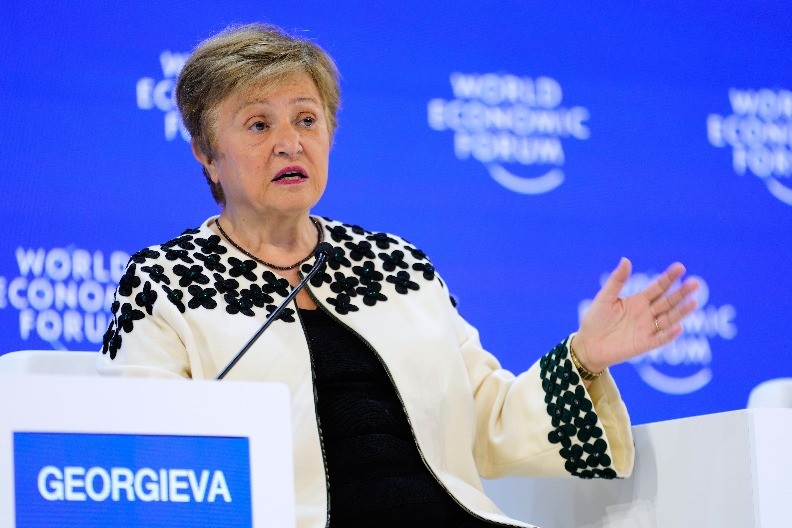
IMF Managing Director Kristalina Georgieva has warned that global economies must brace for what she called “unimaginable shocks,” stressing that continuing turbulence—especially from the conflict in the Middle East—could significantly damage growth and fuel inflation. Across both opposition and pro-government coverage, reports agree that she flagged the risk that a sustained 10% rise in energy prices would add around 40 basis points to global inflation while dampening output, and that she singled out highly energy-dependent economies, including Japan, as particularly exposed to stagflation pressures due to reliance on Middle Eastern oil and currency vulnerabilities. Both sides also concur that she urged governments to stay in a constant state of preparedness for further instability in markets and geopolitics.
Opposition and pro-government outlets alike describe Georgieva’s prescriptions in similar terms: strengthening domestic institutions, investing in resilience, and prioritizing private sector-led growth are framed as the IMF’s main policy recommendations. There is broad agreement that she called for sound macroeconomic management to absorb future shocks, including more prudent fiscal policy, better inflation management, and improved crisis-response capacity. Both perspectives also stress the IMF’s role as a central actor in monitoring global risks, using scenarios around energy prices, geopolitical conflict, and supply disruptions to illustrate how quickly inflation and growth trajectories can be knocked off course.
Areas of disagreement
Severity and framing of the threat. Opposition-aligned sources tend to frame Georgieva’s language about “unimaginable shocks” as evidence that the global system is on the brink of a far deeper crisis than official forecasts admit, sometimes amplifying the phrase as a headline warning of systemic failure. Pro-government outlets, by contrast, repeat the same wording but cast it more as a call for alertness and prudent planning, emphasizing that the risks are conditional and manageable if governments act responsibly. While opposition media often highlight the specter of cascading crises and social hardship, pro-government reporting underscores continuity, focusing on technocratic risk management rather than existential alarm.
Responsibility and blame. Opposition coverage typically uses Georgieva’s warning to argue that current economic vulnerabilities stem from policy mismanagement at home, pointing to inflation episodes, debt build-ups, or energy dependence as failures of the sitting government. Pro-government sources instead highlight external drivers such as the Middle East conflict, global energy markets, and exchange-rate dynamics, implying that domestic authorities are more victims than authors of these risks. Where opposition outlets suggest that the warning exposes structural weaknesses created or worsened by those in power, pro-government narratives stress that the same government is proactively responding to unavoidable global headwinds.
Policy prescriptions and IMF guidance. Opposition outlets tend to interpret the IMF’s call for stronger institutions and private sector-led growth as an implicit critique of current economic governance, arguing that entrenched interests, corruption, or state-heavy models undermine the resilience Georgieva demands. Pro-government coverage presents the same guidance as validation of existing reform agendas, highlighting compatible policies such as fiscal consolidation, investment incentives, or regulatory changes as proof of alignment with IMF advice. As a result, the IMF message is framed by the opposition as a benchmark the government is failing to meet, while pro-government media frame it as external endorsement of the policy course already chosen.
Distributional impact and social risk. Opposition reporting often extrapolates from Georgieva’s warnings to focus on how higher energy prices and slower growth could hit ordinary households, small businesses, and vulnerable groups, portraying the shock as likely to deepen inequality and social strain. Pro-government outlets give comparatively less attention to distributional fallout and more to macroeconomic metrics like inflation rates, growth forecasts, and currency stability, suggesting that maintaining aggregate stability will indirectly protect living standards. Thus, while the opposition emphasizes prospective social unrest and hardship as central to the risk, pro-government sources largely keep the discussion at the level of national economic management and investor confidence.
In summary, opposition coverage tends to use Georgieva’s warning as a spotlight on domestic policy failures and looming social costs, while pro-government coverage tends to depict the same warning as a largely external challenge that can be contained through prudent, ongoing reforms and responsible economic management.