
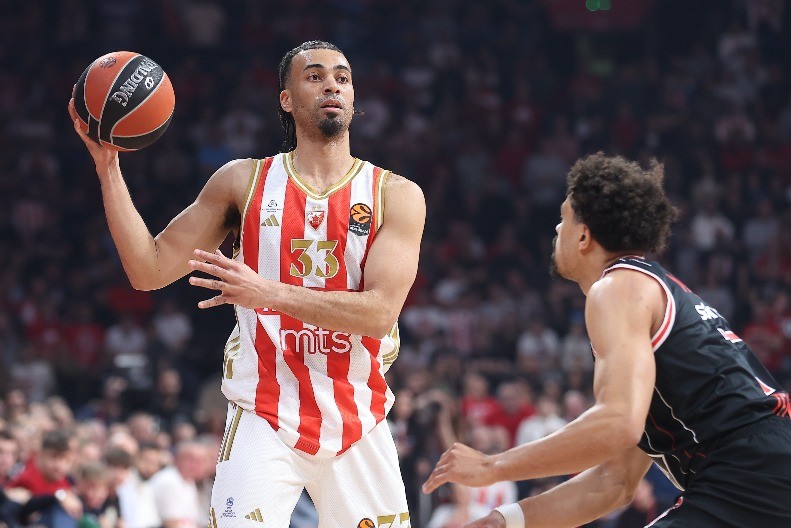
Jordan Nwora, a key player for Crvena zvezda, is being linked with a possible move to Real Madrid for next season, with reports consistently stating that the Spanish giant has shown concrete interest. The coverage agrees that Crvena zvezda holds an option to extend Nwora's contract but faces a serious challenge in exercising it, largely because of his standout 2024–25 campaign in the EuroLeague and regional competition, where he is averaging around 17.5 points, 4.4 rebounds, and a performance index rating of approximately 16.5.
Both sides acknowledge that Real Madrid, as one of Europe's most powerful and wealthy basketball institutions, is capable of offering a financial package and sporting project that few clubs in the region can match. They agree that Nwora's surge in form has increased his market value and visibility, making him a natural target for elite clubs and complicating Zvezda's long‑term roster planning. There is shared recognition that the situation reflects broader structural realities in European basketball, where clubs from smaller markets regularly develop or showcase players who are then recruited by financially stronger teams, and that any eventual decision will be shaped by contract clauses, salary space, and Nwora's own career ambitions.
Areas of disagreement
Framing of Zvezda’s position. Opposition-aligned sources portray Crvena zvezda as structurally unable to keep top talent, emphasizing financial constraints, unstable management, and a pattern of losing stars to richer Western clubs, while pro-government outlets frame the club as a respected regional power that inevitably becomes a feeder to Europe’s elite but still negotiates from a position of sporting strength. The former stress that the contract extension option is mostly symbolic because Zvezda cannot credibly match Real’s offer, whereas the latter highlight that the option gives Zvezda leverage to demand a buyout or at least influence the timing of any transfer. Opposition coverage, where it appears, tends to weave Nwora’s case into a broader narrative of mismanagement in domestic sport, while pro-government pieces isolate it as a routine market development.
Interpretation of Nwora’s performances. Opposition sources use Nwora’s strong stats to argue that Zvezda’s success rests on a few standout individuals whom the club cannot retain, suggesting a lack of long-term sporting strategy, while pro-government media celebrate his performances as proof that Zvezda is an attractive platform capable of reviving or elevating players’ careers. The opposition leans on his averages to underscore the risk of a sharp decline in competitiveness if he leaves, portraying him as almost irreplaceable under current conditions. Pro-government outlets instead stress that, although his departure would be a blow, Zvezda has a track record of recruiting new impactful players and that the club’s system, not just one star, underpins results.
Political and symbolic implications. Opposition-aligned coverage tends to connect the possible transfer to a wider story of Serbia’s sporting and economic “brain drain,” implicitly blaming government-linked sports structures for failing to build clubs that can hold on to elite talent, while pro-government sources largely avoid political framing and treat the move as normal business in a globalized market. For the opposition, Nwora’s potential exit is another example of how public or para-public money goes into projects that cannot compete sustainably, whereas pro-government media emphasize positive visibility for Serbian basketball when a domestic club’s player is targeted by Real Madrid. As a result, the same rumor becomes, for one side, a symptom of systemic weakness and, for the other, a sign of international recognition.
In summary, opposition coverage tends to cast Nwora’s possible move as evidence of structural and political failings that prevent Serbian clubs from retaining top players, while pro-government coverage tends to present it as a routine and even flattering consequence of Crvena zvezda successfully showcasing elite talent for Europe’s biggest teams.