
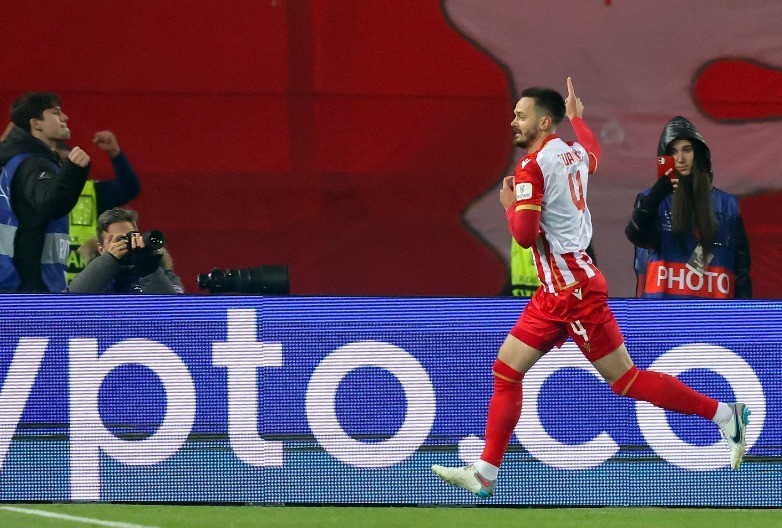
Mirko Ivanić, a key playmaker for Red Star Belgrade, has been sidelined for more than three months with a calf injury suffered during the club’s winter training period. Across outlets, reports agree that he attempted an early comeback in the first match of the second half of the season but was withdrawn after the problem persisted, and medical staff decided on a longer recovery period. Now, according to club-linked medical updates reported by the media, he is expected to resume running this week and, provided there are no setbacks, gradually rejoin full team training with a targeted return to official matches after the upcoming international break.
Coverage also converges on the broader context: Ivanić is considered one of the most important creative players in the squad, and his absence has been felt in Red Star’s midfield organization and attacking fluency. The injury is framed as a typical overuse or training-related calf issue rather than the result of any single dramatic incident, and both sides reference the club’s intention to avoid rushing him back to reduce the risk of re-injury. There is shared acknowledgment that his return timeline is being carefully staged—light running first, then integration into collective sessions—within the club’s standard medical protocols and seasonal planning.
Areas of disagreement
Framing of the club’s handling. Opposition-aligned outlets tend to depict the earlier attempted return as mismanaged, implying that the medical and coaching staff may have rushed Ivanić back and thereby prolonged his absence, whereas pro-government media describe that episode more mildly as an unfortunate but understandable setback in a complex recovery. While opposition sources emphasize potential negligence or pressure on the player to appear in key matches, pro-government coverage stresses that the club followed normal procedures and adjusted the plan as soon as discomfort reappeared. This leads to a contrast between a narrative of institutional error and one of professional caution fine-tuned over time.
Impact on results and responsibility. Opposition outlets are more likely to link Ivanić’s long absence directly to Red Star’s less convincing performances, using his injury as a symbol of broader squad-planning or depth problems that they implicitly tie to current football and sports governance. Pro-government sources, by contrast, underline the team’s ability to cope without him, highlighting other players’ contributions and downplaying any crisis, thus framing Ivanić’s return as a welcome boost rather than a remedy to systemic failings. In doing so, opposition coverage assigns responsibility for any on-pitch dips to leadership decisions around fitness and rotation, while pro-government coverage disperses responsibility and stresses collective resilience.
Interpretation of the comeback timeline. Opposition-leaning reporting tends to question the shifting projections for Ivanić’s return, framing the evolving timeline as a sign of poor planning or opaque communication from the club’s hierarchy. Pro-government outlets present the same timeline as a textbook example of a cautious, step-by-step approach, emphasizing that long muscle injuries often require adjustments and that postponing his comeback beyond the international break is a sign of prudence. Thus, while opposition voices treat the moving schedule as evidence of instability or spin, pro-government voices treat it as a medically grounded response to a sensitive injury.
In summary, opposition coverage tends to use Ivanić’s injury and delayed return to spotlight alleged mismanagement, communication issues, and wider structural weaknesses, while pro-government coverage tends to frame the same facts as an example of responsible medical caution, squad depth, and stable club governance.