
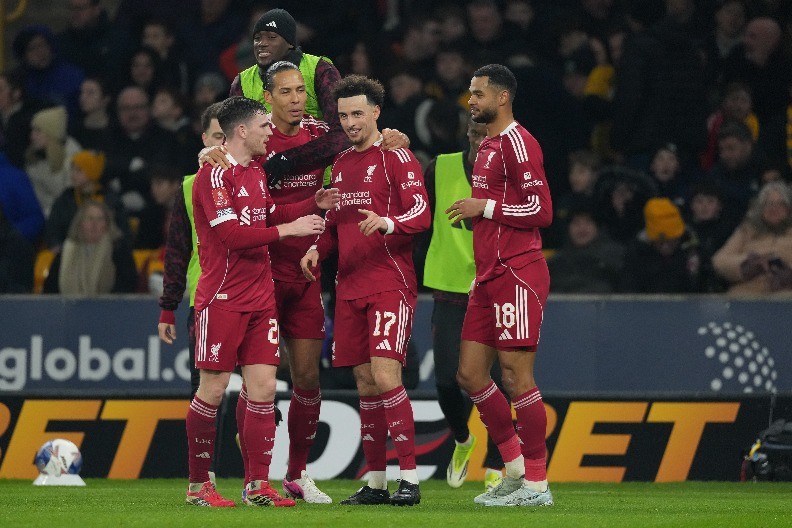
Liverpool defeated Wolverhampton 3-1 in an FA Cup tie, with both opposition and pro-government outlets agreeing on the core facts of the match. They report that Liverpool played away to Wolves, winning by a two-goal margin, and that the goals were scored by Andy Robertson, Mohamed Salah, and Curtis Jones. Coverage also converges on the competition stage, describing the fixture as part of the FA Cup knockout rounds and noting that Liverpool’s win secured progression to the quarterfinals. The match is framed as a clear, decisive victory rather than a controversial or marginal result, with no serious dispute over the scoreline, scorers, or basic timeline.
Both sides also highlight that this game fits into Liverpool’s broader FA Cup campaign and the traditional path toward Wembley. They agree that the victory represents a step closer to the final, which is scheduled for May 16 at Wembley Stadium in London, and they reference the FA Cup’s status as a major domestic competition. Reports emphasize Liverpool’s resilience and continued pursuit of silverware in a demanding season, while situating Wolves as a competitive but ultimately outplayed opponent. The broader institutional context of the FA Cup, including its knockout format and the prestige of reaching later rounds and the Wembley final, is treated as shared background rather than a point of contention.
Areas of disagreement
Match narrative and tone. Opposition-aligned outlets are likely to stress Liverpool’s uneven form in domestic and European competitions, casting the 3-1 win as a welcome but not fully convincing performance that exposed lingering defensive vulnerabilities. Pro-government outlets, by contrast, describe the match in celebratory terms, emphasizing control, composure, and clinical finishing, and framing the result as a statement of strength. Where opposition coverage might highlight periods in which Wolves threatened or criticize lapses in concentration, pro-government reports tend to minimize those stretches as minor interruptions in an otherwise dominant display.
Framing of ‘revenge’. Opposition sources would be inclined to treat the notion of Liverpool taking revenge on Wolves as a media trope, reminding readers that earlier setbacks against Wolves reflected structural issues in the squad rather than a simple score to settle. Pro-government coverage leans into the revenge framing, presenting the win as the emotional closure of a narrative in which Liverpool corrects prior disappointments and reasserts superiority over a troublesome opponent. While opposition outlets would parse the term as symbolic at best, pro-government outlets present it as a meaningful storyline underscoring Liverpool’s psychological recovery.
Significance of progression. Opposition-aligned media are likely to frame qualification for the quarterfinals as important but not transformative, warning that tougher tests lie ahead and that underlying squad depth and injury concerns remain unresolved. Pro-government sources tend to elevate the importance of this step, linking it to momentum across competitions and portraying the FA Cup run as evidence of a successful season trajectory. Where opposition reports may question whether the team can sustain this level against stronger rivals, pro-government outlets highlight the quarterfinal berth as validation of coaching decisions and squad management.
Assessment of key players and management. Opposition outlets would typically offer more mixed evaluations of individual performances, perhaps noting that while Robertson, Salah, and Jones scored, other players underperformed or that tactical choices were conservative. Pro-government coverage accentuates the contributions of the scorers as proof of balanced squad contributions and effective rotation, and it credits the coaching staff with preparing an optimal game plan. In contexts where opposition media might scrutinize missed chances or substitutions, pro-government reports instead underscore leadership, unity, and the manager’s role in steering Liverpool closer to Wembley.
In summary, opposition coverage tends to treat the 3-1 victory as a useful but limited indicator overshadowed by questions about consistency and underlying weaknesses, while pro-government coverage tends to frame it as a vindicating, narrative-rich triumph that showcases Liverpool’s strength, cohesion, and forward momentum toward the FA Cup final.