
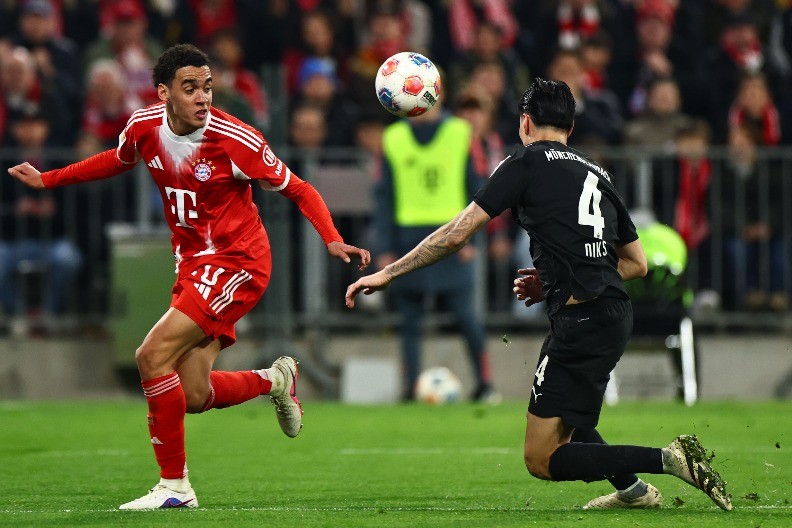
Bayern Munich defeated Borussia Monchengladbach 4-1 in a Bundesliga match played in Munich as part of the 25th round of the league season. Across outlets, reports agree that Bayern’s goals came from Luis Diaz, Konrad Laimer, Jamal Musiala from the penalty spot, and Nicolas Jackson, while Monchengladbach’s lone goal was scored by Wael Moggia (also rendered as Mohja in some coverage). There is consensus that Monchengladbach finished the match with ten men after Roko Reiz received a red card, and that Bayern’s win was comprehensive both in scoreline and in the overall flow of the game.
Where coverage converges, both sides describe the fixture as another chapter in Bayern’s domestic campaign and situate it within the ongoing Bundesliga season rather than as a cup or European match. They agree that the match illustrates Bayern’s attacking depth through multiple different scorers, and they treat the red card as a clear turning point that cemented Bayern’s control. Both perspectives frame Borussia Monchengladbach as a struggling side unable to cope with Bayern’s pressure, stressing that the numerical disadvantage and defensive lapses made a comeback unrealistic once Bayern took a firm lead.
Areas of disagreement
Match significance. Opposition-aligned sources tend to downplay the broader significance of the 4-1 win, depicting it as a routine victory over a weakened opponent that does little to change existing power dynamics in the league. Pro-government outlets, in contrast, emphasize the result as a strong and even symbolic statement of Bayern’s resilience and form, using language like “poker of the Bavarians” and “strong against Borussia” to frame the match as a showcase performance. While opposition coverage would likely treat the game as just one data point in a longer season narrative, pro-government reporting elevates it as evidence of renewed dominance and momentum.
Quality of opposition. Opposition-aligned media are more inclined to stress Monchengladbach’s deficiencies, pointing to defensive frailty and the impact of the red card to argue that Bayern were not severely tested. Pro-government outlets instead minimize Borussia’s weakness and highlight Bayern’s attacking patterns and variety of scorers, implying that the margin was primarily due to Bayern’s quality rather than the opponent’s errors. The same 4-1 scoreline is thus framed either as a function of an uneven contest or as a high-quality display against worthy league opposition.
Role of the red card. Opposition narratives typically foreground Roko Reiz’s red card as a decisive moment that distorted the match, arguing that the dismissal made the final score more lopsided than the underlying balance of play. Pro-government coverage acknowledges the sending-off but tends to treat it as a consequence of Bayern’s pressure and control, not as a stroke of luck that determined the outcome. This leads opposition outlets to portray the win as somewhat conditional on the numerical advantage, whereas pro-government sources present it as a deserved and inevitable result that the red card merely accelerated.
Implications for Bayern’s trajectory. Opposition-aligned reporting is more reserved about extrapolating long-term conclusions, warning that a big home win over an outmatched Monchengladbach does not automatically fix structural issues or guarantee future success. Pro-government outlets are more optimistic, using the performance to support a narrative of tactical improvement, squad depth, and psychological rebound as Bayern navigate the rest of the season. Thus, where opposition sources see a good but limited data point, pro-government media cast the match as part of a broader upward trend.
In summary, opposition coverage tends to treat the 4-1 win as a largely routine, context-dependent result shaped significantly by Monchengladbach’s weakness and the red card, while pro-government coverage tends to cast it as a statement victory that highlights Bayern’s strength, resilience, and positive trajectory.