
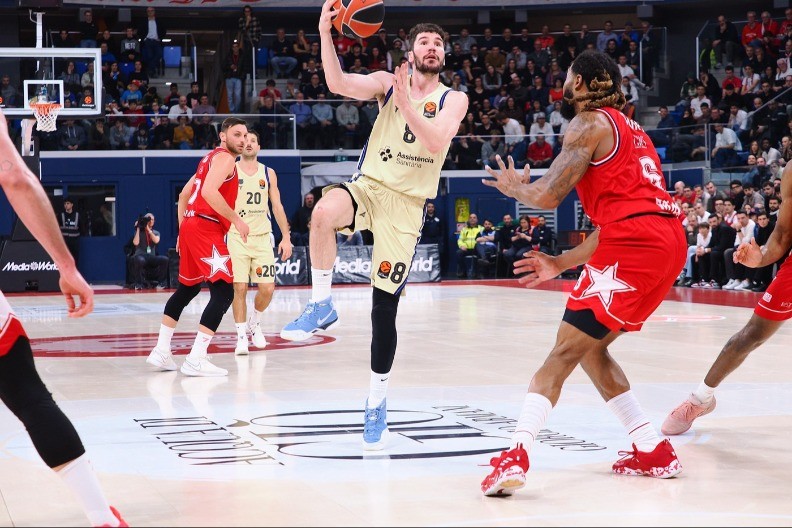
Olimpia Milano defeated Barcelona 87-84 in a EuroLeague regular-season game, with coverage agreeing that Milano led comfortably for most of the match before nearly squandering the advantage in a chaotic final quarter. Reports concur that Barcelona mounted a huge late surge, outscoring Milano by a wide margin in the last period and coming close to forcing overtime or stealing the win, but ultimately ran out of time. The final scoreline, the narrow three-point margin, and the characterization of Barcelona’s run as a near-miraculous comeback or near-historic turnaround are consistent across outlets.
Both sides also agree that the game carries meaningful implications for the EuroLeague playoff picture, not only for Milano and Barcelona but also for other contenders such as Crvena Zvezda. The result is framed as strengthening Olimpia Milano’s position and complicating Barcelona’s path, with shared recognition that such close head-to-head games can heavily influence seeding and qualification scenarios. Common context emphasizes the high stakes of late-season EuroLeague fixtures, where point differences, tie-breakers, and momentum are crucial for clubs and their domestic supporters.
Areas of disagreement
Game quality and narrative emphasis. Opposition-aligned outlets tend to emphasize the sloppiness of Milano’s near-collapse and underline Barcelona’s late charge as evidence of systemic fragility in Milan’s game management. Pro-government coverage, by contrast, highlights Milano’s overall control for most of the match and describes the late scare more as drama that adds excitement than as proof of deep flaws, framing the result as a deserved and valuable win.
Impact on regional interests. Opposition sources are more likely to downplay the benefit for Crvena Zvezda or present it as marginal, stressing that Zvezda’s fate still depends primarily on its own inconsistent performances. Pro-government outlets foreground how this result “brings good news” for Zvezda, stressing that Barcelona’s loss may open up playoff avenues or improve seeding scenarios for the Belgrade club, thus tying the match directly to national or regional sporting interests.
Responsibility for the near-collapse. Opposition reporting generally attributes Milano’s late-game problems to coaching decisions, poor rotations, and a lack of mental toughness, using the scare as a case study in mismanagement. Pro-government coverage tends to attribute the fourth-quarter swing more to Barcelona’s quality and inevitable push, implying that any strong EuroLeague opponent can engineer such a run, and thus casting Milano’s survival as a mark of resilience rather than incompetence.
Broader EuroLeague narrative. Opposition sources often fit the game into a broader story of unpredictability and instability in EuroLeague play, suggesting that results like this show how fragile any team’s position can be and questioning the consistency of clubs connected to domestic interests. Pro-government outlets instead weave the match into a more optimistic narrative of EuroLeague opportunities for regional teams, presenting Milano’s win and Barcelona’s setback as part of a shifting landscape that clever, well-run clubs from the region can exploit.
In summary, opposition coverage tends to stress Milano’s near-failure, structural weaknesses, and a more cautious reading of what the result means for Crvena Zvezda, while pro-government coverage tends to frame the win as controlled and positive, highlighting resilience and emphasizing the beneficial playoff implications for regional clubs.