

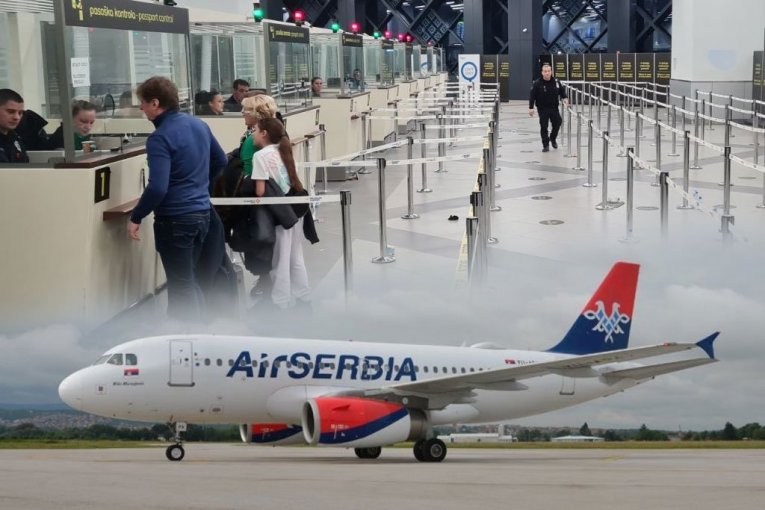
Flights from Belgrade’s Nikola Tesla Airport to Doha and Dubai operated by Qatar Airways and Fly Dubai have been canceled, with at least one inbound flight from Dubai to Belgrade also called off. Both opposition and pro-government outlets agree that these cancellations are directly linked to the deteriorating security situation in the Middle East, with airlines adjusting or suspending routes in response to heightened risks and airspace disruptions.
Coverage from both sides notes that these disruptions in Belgrade fit into a broader pattern of regional aviation instability triggered by the latest escalation of conflict in the Middle East, involving Israel, the United States, and armed groups in the region. They converge on the view that airspace restrictions, security protocols, and risk assessments by carriers and authorities are driving the cancellations, and that passengers across multiple countries are facing delays, reroutings, and uncertainty as airlines continually reassess their operations.
Areas of disagreement
Scale and framing of the disruption. Opposition outlets describe the Belgrade–Doha and Belgrade–Dubai cancellations in a restrained, factual tone, treating them as specific affected routes and mentioning only the relevant flights and carriers. Pro-government media frame the situation as a “total collapse,” emphasizing dramatic language and suggesting a sweeping, near-systemic breakdown in air traffic. While opposition coverage keeps the focus local and limited to today’s cancellations, pro-government narratives stress a global cascade of over a thousand canceled flights and far-reaching chaos.
Attribution of causes. Opposition reporting links the cancellations broadly to the Middle East conflict and general security concerns without going into geopolitical blame or detailed military causality. Pro-government outlets explicitly connect the disruption to the “US-Israeli conflict” and retaliatory actions, presenting a more pointed geopolitical causal chain. The result is that opposition coverage portrays the cancellations as a security-driven operational response, whereas pro-government reporting embeds them within a more accusatory narrative about Western and Israeli actions destabilizing regional air traffic.
Scope beyond Serbia. Opposition sources largely confine their attention to Belgrade’s airport, referencing the outbound Doha and Dubai flights and a canceled inbound Dubai service without elaborating on impacts elsewhere. Pro-government sources broaden the picture, highlighting closures or restrictions of airspace over parts of the Middle East, disruptions at major hubs like Dubai, and passengers stranded “worldwide.” Thus, opposition coverage reads as a localized transport notice, while pro-government coverage situates Belgrade’s cancellations inside a sweeping, transnational crisis.
Implications and tone toward authorities. Opposition media tend to avoid judging Serbian aviation authorities, focusing instead on the immediate information passengers need, such as which flights are canceled and when. Pro-government coverage, by invoking official airport statements and situating Nikola Tesla Airport as one of many affected by external geopolitical turmoil, implicitly absolves domestic institutions of responsibility and underscores their responsiveness. Consequently, opposition outlets appear neutral and service-oriented, while pro-government outlets are more defensive of local actors and suggest Serbia is a victim of forces beyond its control.
In summary, opposition coverage tends to present the Belgrade–Doha and Belgrade–Dubai cancellations as limited, factual disruptions tied generally to Middle East instability, while pro-government coverage tends to dramatize the event as part of a massive global aviation breakdown heavily attributed to US-Israeli actions and external geopolitical forces.
