

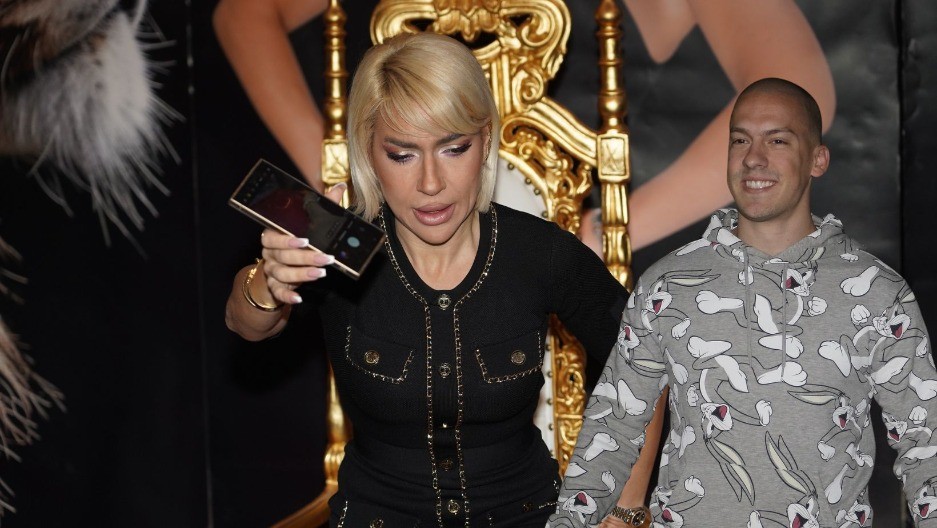
Media across the spectrum agree that a public feud has erupted between television host Jovana Jeremić and YouTuber Baka Prase following her recent viral statement that "a man without money is like a village without a church." They concur that Baka Prase mocked her on a live stream, saying he would rather have all his cars burned than have Jeremić as his wife, alluding to the recent burning of his vehicle, and that Jeremić responded in kind by calling him a "little stinker" and claiming he had been blackmailed or "extorted a little." Outlets also consistently place the exchanges on social media and in television segments, emphasizing that the spat quickly spread online and became a trending celebrity-gossip story, with direct insults and insinuations traded in public rather than handled privately.
Across both opposition and pro-government coverage, the feud is framed against the backdrop of Serbia’s influencer and tabloid-driven media culture, where reality TV, YouTube celebrities, and morning-show hosts routinely generate political and social debates. Both sides highlight that Jeremić is a prominent host on a major pro-government television channel and that Baka Prase has a long history of online controversies and prior clashes with the media and authorities. They agree the argument touches recurring themes in Serbian public discourse, such as money, status, and gender expectations, and that these personal disputes often serve as a proxy stage for broader ideological conflicts over media ethics, youth culture, and the normalization of vulgarity in public life.
Areas of disagreement
Framing of the feud’s importance. Opposition-aligned outlets tend to treat the Jeremić–Baka Prase clash as a symptom of the wider degradation of public discourse under a tabloidized, regime-friendly media system, suggesting it crowds out coverage of issues like corruption or governance. Pro-government outlets, by contrast, present it largely as a colorful celebrity spat and entertainment content, minimizing any broader political or moral implications. While opposition media imply such stories are deliberately amplified to distract the public, pro-government media emphasize audience interest and click-driven logic as sufficient explanation.
Portrayal of Jovana Jeremić. Opposition media are more likely to cast Jeremić as a symbol of loyal, sensationalist television that reflects and serves the ruling party’s values, characterizing her comments on money and relationships as crass and socially harmful. Pro-government outlets depict her as a confident, outspoken host defending traditional expectations that men should be providers, highlighting her sharp wit and framing her insults as justified pushback against disrespect. Where opposition coverage questions her professionalism and the example she sets, pro-government coverage stresses her ratings, popularity, and alleged authenticity.
Portrayal of Baka Prase. Opposition outlets, when critical, tend to portray Baka Prase as part of a larger problem of influencer culture but also underscore his previous run-ins with authorities to suggest selective targeting by the state and its media allies. Pro-government media underline his long record of scandals and controversies to present him as inherently vulgar and unreliable, implying his attack on Jeremić is just another instance of his problematic behavior. Thus, opposition narratives see him as problematic yet occasionally a victim of power structures, whereas pro-government narratives see him primarily as an aggressor who deserves rebuttal.
Attribution of ulterior motives. Opposition-aligned sources are inclined to suggest that amplifying this feud on major television platforms functions as soft propaganda, distracting from political scandals and reinforcing a value system centered on money and spectacle. Pro-government outlets, on the other hand, describe the feud as spontaneous and driven by personal ego clashes and online virality, denying any orchestrated political intent. For opposition media the conflict is politicized by design, while for pro-government media it is depoliticized, treated as mere gossip content in a competitive media market.
In summary, opposition coverage tends to connect the Jeremić–Baka Prase feud to a deeper critique of regime-aligned media, moral decline, and distraction from serious politics, while pro-government coverage tends to frame it as an entertaining personal spat that showcases a popular host standing up to a controversial influencer.