

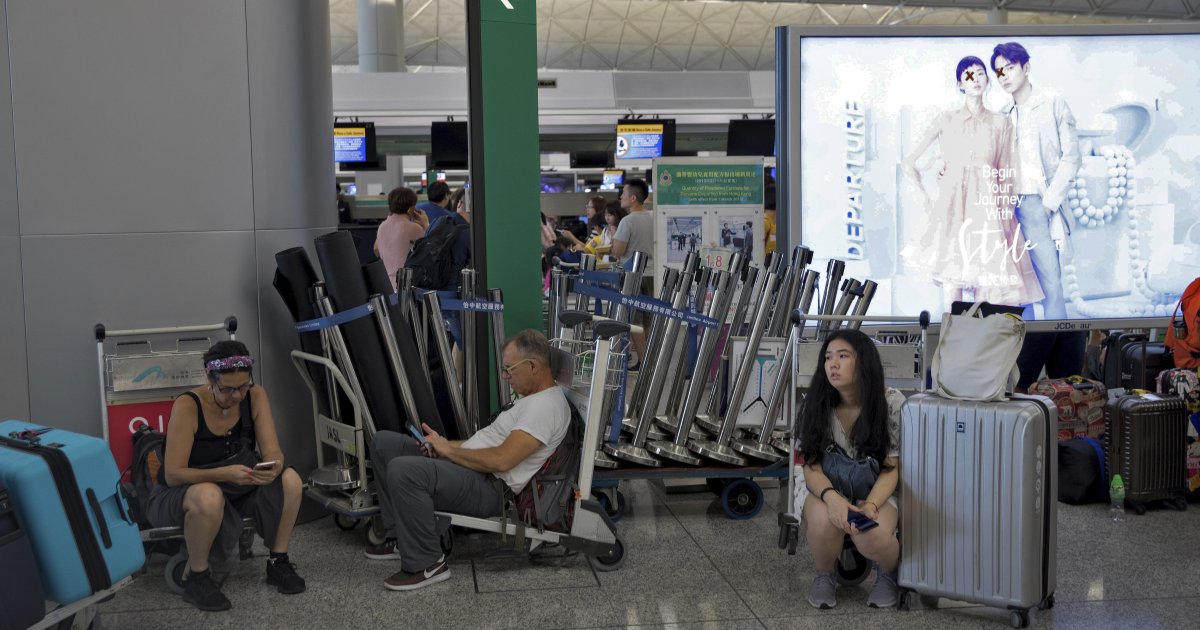
A 35-year-old British tourist was arrested at Hong Kong International Airport after going on a rampage at Terminal 1, during which he smashed around 10 airline check-in counters and damaged screens using a metal bar and an airport trolley. Both opposition and pro-government-leaning reports agree that the incident took place in the public departure area, was filmed by bystanders, and ended when airport or police officers subdued and arrested the man, who faces at least criminal damage charges and additional scrutiny over four Viagra tablets found in his possession.
Across the spectrum, coverage highlights that possession of prescription-only medication such as Viagra without a valid local prescription is an offence under Hong Kong law, and this formed a separate basis for his arrest alongside the property damage. Outlets from both sides situate the episode within Hong Kong’s strict security and public-order framework at the airport, noting that the case will likely involve a court process assessing both the value of damaged property and the legality of the medication, and reference Hong Kong’s regulatory system that tightly controls pharmaceuticals and emphasises public safety in major transport hubs.
Points of Contention
Framing and tone. Opposition-aligned sources tend to frame the incident in more sober legal terms, focusing on due process, potential mental health issues, or the proportionality of dual charges for damage and unprescribed medication. Pro-government outlets, by contrast, use sensational headlines, viral video angles, and tabloid-style language to dramatize the rampage and highlight the Viagra detail as a curiosity. While opposition reporting is more likely to contextualize the event within patterns of policing and foreigners’ treatment under Hong Kong law, pro-government coverage centers on the shock value and the spectacle of the destruction.
Emphasis on public order vs. individual circumstances. Opposition sources are more inclined to question whether the rampage suggests underlying stress, intoxication, or mental health problems that might mitigate culpability or call for support rather than purely punitive responses. Pro-government outlets emphasize the threat to public order and airport operations, underscoring the need for strict enforcement to deter similar acts and reassure the public about security. The former may query whether charging over the Viagra tablets is an overreach, whereas the latter present it as a straightforward application of existing law.
Characterization of Hong Kong’s legal system. Opposition coverage tends to place the case within a broader narrative about stringent controls and the potential harshness of Hong Kong’s legal environment, especially for foreign nationals unfamiliar with local drug and public-order regulations. Pro-government reporting instead uses the case to illustrate the clarity and firmness of Hong Kong’s legal regime, portraying the swift arrest as proof that laws are applied consistently and effectively to maintain order. Thus, opposition accounts lean toward cautious criticism or concern about possible over-criminalization, while pro-government sources highlight rule-of-law strength and deterrence.
Political and reputational subtext. Opposition-aligned media may hint that international stories like this feed into wider debates about Hong Kong’s global image, suggesting that highly publicized arrests can reinforce perceptions of an increasingly rigid or unforgiving jurisdiction. Pro-government outlets, however, portray the event as a one-off misbehavior by a visitor that Hong Kong authorities handled decisively, arguing this actually bolsters the city’s reputation as a safe, well-regulated aviation hub. Where the opposition sees reputational risk linked to heavy-handedness, pro-government coverage sees reputational protection through zero tolerance for disorder.
In summary, opposition coverage tends to treat the case as an example of how strict laws, prosecutorial choices, and foreign defendants intersect in today’s Hong Kong, while pro-government coverage tends to spotlight the sensational aspects of the rampage to reinforce a message of firm public-order enforcement and a robust legal system.
