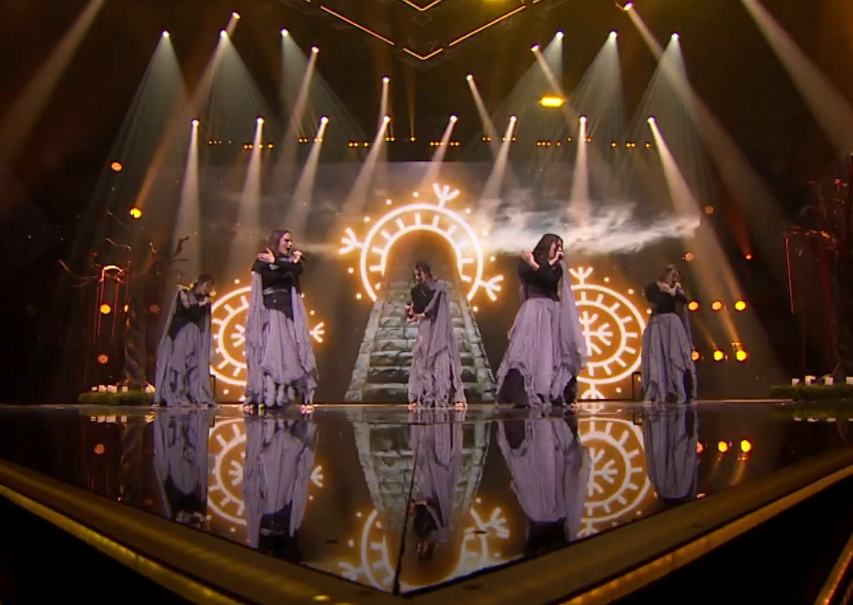


Lelek, a Croatian ethno-pop vocal group formed in 2024, has won Dora, Croatia’s national selection for the Eurovision Song Contest, with the song “Andromeda.” Across both opposition and pro‑government-leaning coverage, there is agreement that the track will represent Croatia at Eurovision 2026 in Vienna, Austria, where the semi‑finals are scheduled for May 12 and 14 and the grand final for May 16. Reports concur that the song’s music was co‑written by Serbian artist Zorica Pajić (Zorja) together with her husband Lazar, that she also provided backing vocals, and that Lelek’s victory came through a combination of jury and public votes. All outlets frame Lelek as a five‑member young vocal ensemble blending ethno and pop elements.
There is also broad agreement that “Andromeda” stylistically fuses traditional and modern sounds, drawing on Slavic and regional cultural motifs that have become a recognizable aesthetic in recent Eurovision entries from the Balkans. Media on both sides note the longstanding role of Dora as Croatia’s selection platform and situate Lelek’s win within Croatia’s broader attempts to improve its Eurovision results by experimenting with fresher acts and more distinctive genres. Coverage emphasizes that cross‑border artistic collaboration between Croatian and Serbian musicians, while sometimes politically sensitive, has been a recurring feature of the regional music scene since the 1990s. Outlets additionally highlight the social‑media circulation of Pajić’s emotional reaction to the win as a symbol of the song’s immediate visibility and potential to attract regional attention ahead of the contest.
Points of Contention
National identity and symbolism. Opposition-aligned sources tend to frame the choice of a Croatian entry co-written by a Serbian artist as a missed opportunity to promote purely domestic talent and a dilution of national representation on one of Europe’s largest stages. Pro-government outlets instead treat the collaboration as a positive symbol of regional cultural ties and a sign of Croatia’s modern, open identity that can appeal to a broader audience. While opposition commentary may question whether the project adequately reflects Croatian heritage, pro-government coverage stresses that the Slavic and local motifs in “Andromeda” still anchor the performance firmly in Croatian culture.
Political subtext and regional relations. Opposition coverage is more likely to read the selection as carrying an implicit political message, suggesting that elevating a Serbian co-writer in Croatia’s Eurovision project could be interpreted as signaling elite-driven reconciliation that does not necessarily match public sentiment. Pro-government media, by contrast, downplay overt political implications and present the collaboration as an organic artistic partnership, portraying it as proof that cultural exchange can transcend historic tensions. The former tend to ask who benefits politically from such symbolism, whereas the latter argue that normalizing cross-border teamwork benefits both societies and enhances Croatia’s soft power.
Framing of authorship and credit. Opposition-leaning outlets are more prone to emphasize that a “Serbian song” is effectively representing Croatia, sometimes foregrounding Pajić’s authorship over Lelek’s role to question whether the national brand is being outsourced. Pro-government sources acknowledge Pajić’s contribution but keep Lelek at the center of the narrative, referring to “Croatia’s group Lelek” and describing Pajić as a co-writer and backing vocalist rather than the primary face of the entry. This leads opposition narratives to stress external influence and dependence, while pro-government coverage highlights joint creativity within a Croatian-led project.
Cultural strategy and Eurovision success. Opposition narratives often suggest that relying on cross-border ethno-pop formulas is a risk that may not translate into votes, arguing that Croatia should instead invest in more distinctively national or innovative concepts to stand out. Pro-government outlets argue that this hybrid ethno-pop approach is precisely what has helped several countries perform well at Eurovision recently and present “Andromeda” as a calculated, modern strategy to improve Croatia’s results. Where opposition voices see experimentation with foreign collaborators as uncertain and potentially unnecessary, pro-government coverage casts it as a savvy adaptation to Eurovision’s evolving musical and political landscape.
In summary, opposition coverage tends to question the national, political, and strategic wisdom of sending a Croatian entry co-created by a Serbian artist, while pro-government coverage tends to portray the Lelek–Pajić collaboration as a modern, culturally rich partnership that strengthens Croatia’s Eurovision prospects and regional image.
Story coverage