


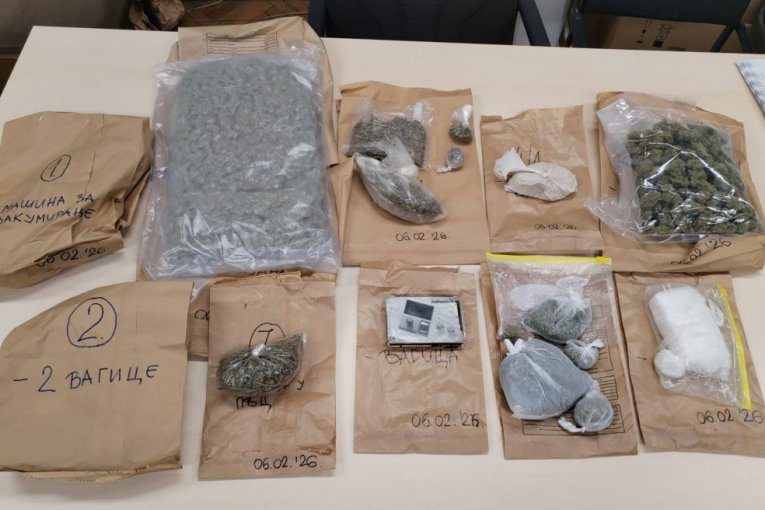
Police in Niš arrested three individuals on suspicion of drug-related offenses during a coordinated police operation, with both sides of the media landscape reporting the same core facts: three suspects, large quantities of narcotics, and an apartment search. The key figure, identified as N. P., is reported to have been apprehended on suspicion of unauthorized production and trafficking of narcotics, while D. K. and M. G. are described as being suspected of unauthorized possession. In the searched apartment, police reportedly found around 1.8 kilograms of marijuana, roughly 270 grams of cocaine, and around 145 grams of heroin, along with scales, a vacuum sealer, and cash believed to be proceeds of drug sales. Media across the spectrum also agree that police say they caught N. P. during a cocaine sale to D. K., and that M. G. was allegedly found with marijuana he intended to resell and with psychoactive mushrooms in his possession.
Across outlets, there is consensus that the case falls within the broader framework of Serbia’s legal provisions on unauthorized production, trafficking, and possession of narcotics, and that the investigation is being conducted by the police and relevant prosecutorial bodies in Niš. Reports from both opposition and pro-government spheres describe the action as part of ongoing efforts to combat narcotics distribution and street-level dealing, linking the case to routine police crackdowns against organized or semi-organized drug networks. Coverage consistently situates the event within existing institutional mechanisms—criminal procedure, evidentiary searches, and seizure of assets believed to be tied to drug crime—while noting that further proceedings will determine formal indictments and potential court outcomes.
Points of Contention
Framing of the police action. Pro-government outlets present the Niš operation as a significant success in the state’s fight against narcotics, using emphatic language like “major drug seizure” and highlighting the professionalism and efficiency of the police. Opposition-aligned outlets, by contrast, tend to downplay the scale and novelty, framing it as a routine bust that is heavily publicized to create an impression of effectiveness. While pro-government coverage stresses numbers, photos, and operational detail to underscore state capacity, opposition coverage more often treats those same facts as a media spectacle that does not address deeper problems in the drug trade.
Political context and motivation. Pro-government media largely treat the arrests as a straightforward law-enforcement story, separating it from partisan politics and emphasizing continuity in anti-drug operations. Opposition media place the raid within a political narrative, suggesting that authorities selectively amplify such cases to divert public attention from corruption scandals or failures higher in the security apparatus. Where pro-government stories avoid linking the case to any systemic political critique, opposition sources imply that publicizing mid-level busts masks an unwillingness to confront major traffickers allegedly connected to influential circles.
Systemic impact and scale of the problem. Pro-government outlets suggest that seizing kilograms of marijuana and hundreds of grams of cocaine and heroin meaningfully disrupts local distribution networks and demonstrates tangible progress in curbing drug availability. Opposition sources argue that, while the quantities are not negligible, they are small compared with the broader narcotics market, and that such operations have limited long-term impact without structural reforms or action against larger organizations. Thus, pro-government coverage frames the case as evidence that the system is working, whereas opposition reporting questions whether these results are more cosmetic than transformative.
Transparency and follow-up. Pro-government coverage focuses on the immediate facts and images from the operation and briefly notes that the suspects will face further proceedings, trusting institutions to handle the case properly. Opposition-aligned outlets, when they cover similar incidents, tend to raise questions about what happens after the cameras are gone—whether indictments lead to firm convictions, whether plea deals reduce sentences, and whether seized money and assets are transparently tracked. The former implicitly conveys confidence in procedural outcomes, while the latter underscores skepticism and calls for more public scrutiny of case follow-through.
In summary, opposition coverage tends to treat the Niš drug bust as a routine, possibly over-publicized operation that raises questions about systemic impunity and political motives, while pro-government coverage tends to spotlight it as a major, self-contained success story illustrating effective policing and a functioning anti-drug framework.
Story coverage
pro-government
Drug Seizure in Niš
Three arrested, with psychoactive mushrooms found with one.
a month ago